
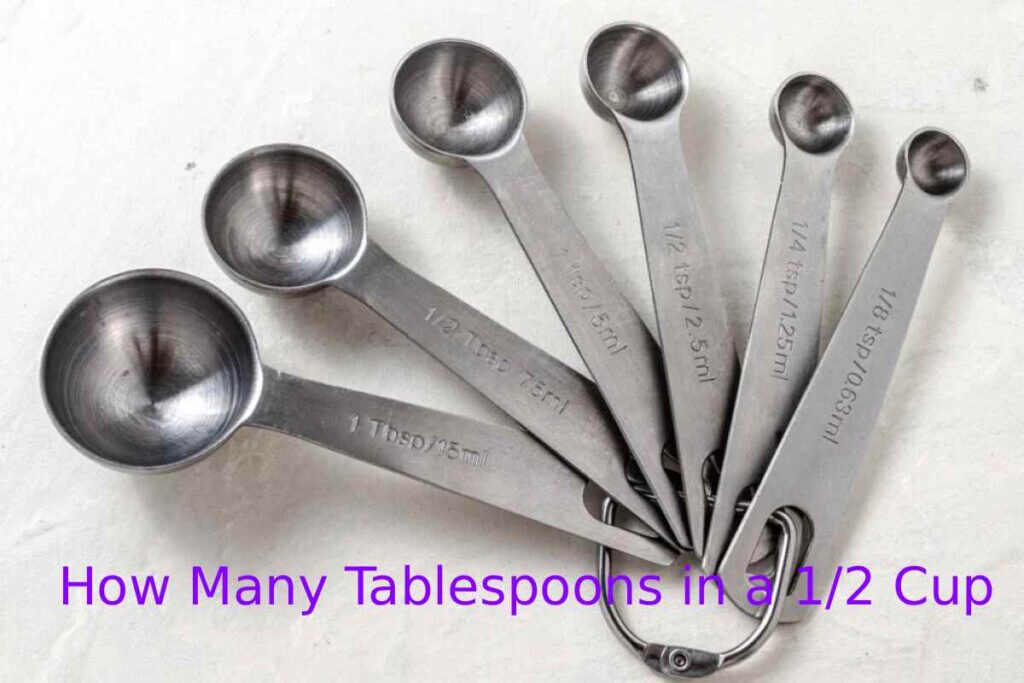
“How many tablespoons in a 1/2 cup?” If you’ve ever stopped mid-recipe and stared at your measuring spoons like they owe you answers, you’re in the right place. I’ll walk you through the plain facts, the why behind them, common pitfalls, helpful conversions (including metric and weight approximations for common ingredients), and the exact gaps most articles skip. This is a practical, no-nonsense overview you can actually use in the kitchen.
The short, irrefutable answer
There are exactly 8 tablespoons in a 1/2 cup.
I’ll show the math so it sticks:
1 cup = 16 tablespoons. Half of 16 is 8. That’s the whole logic — simple and reliable.
Where that number comes from (volume basics)
Understanding the conversion is just knowing the rules of U.S. customary volume:
1 cup = 8 U.S. fluid ounces.
1 U.S. fluid ounce = 2 U.S. tablespoons.
So multiply: 1 cup = 8 fl oz × 2 tbsp/fl oz = 16 tablespoons. Half a cup = 16 ÷ 2 = 8 tablespoons.
If you prefer metric:
1 U.S. cup = 236.588 milliliters (ml).
1 tablespoon (U.S.) = 14.7868 ml.
Divide to check: 236.588 ml (1 cup) ÷ 14.7868 ml (1 tbsp) = 16 tbsp.
Half a cup = 236.588 ÷ 2 = 118.294 ml; 118.294 ml ÷ 14.7868 ml/tbsp = 8 tbsp.
(Yes — the arithmetic confirms the same result.)
Why this matters: real kitchen scenarios
I always keep this conversion handy because it solves three common problems:
No half-cup measure: If a recipe calls for 1/2 cup and you only have tablespoons, scoop 8 level tablespoons.
Scaling recipes: When halving or doubling, converting cups to tablespoons avoids rounding-errors and least-count issues.
Late-night baking: Sometimes all you have are spoons; knowing the conversion keeps the process moving.
Quick cheat sheet (copy/paste or pin it)
| Measurement | Equivalent |
|---|---|
| 1/8 cup | 2 tablespoons |
| 1/4 cup | 4 tablespoons |
| 1/2 cup | 8 tablespoons |
| 3/4 cup | 12 tablespoons |
| 1 cup | 16 tablespoons |
Internal linking suggestion: Link this table to a site page called “Kitchen measurement cheat sheet — cups, tbsp, tsp, ml”.
Liquid vs dry — do conversions differ?
Volume conversions (cups ↔ tablespoons ↔ teaspoons) are the same for liquids and dry ingredients because they measure volume, not weight. That means:
1/2 cup of water = 8 tablespoons (by volume).
1/2 cup of flour = 8 tablespoons (by volume).
Important caveat: weight changes with ingredient density. A packed tablespoon of brown sugar weighs more than a leveled tablespoon of flour. If a recipe lists grams, trust weight measurements for accuracy.
Common measurement traps and how to avoid them
I’ve burned a few batches because I fell for these:
Teaspoon vs tablespoon confusion: 1 tablespoon = 3 teaspoons. Don’t mix them up.
Heaping vs level: A “heaping tablespoon” is not a standard measurement. Use level tablespoons unless the recipe says otherwise.
Different ‘cups’: U.S. customary cup (236.588 ml) is not the same as a metric cup used in some countries (250 ml). If you’re following an international recipe, check which standard it uses.
Measuring sticky stuff: For honey or molasses, spray the spoon with cooking spray or use a scale for accuracy.
Weight approximations for common ingredients
People ask “okay, 8 tbsp of flour — how many grams is that?” Here are practical approximations using standard kitchen practices (remember: these are approximations; weigh if precision matters):
All-purpose flour: 1 tablespoon ≈ 8–9 grams. So 8 tbsp ≈ 64–72 grams.
Granulated sugar: 1 tablespoon ≈ 12.5–15 grams. So 8 tbsp ≈ 100–120 grams.
Butter: U.S. butter sticks are often marked: 1/2 cup = 8 tablespoons = 4 ounces = ~113 grams. So 8 tbsp ≈ 113 grams.
Why include these? Because many recipes switch between volume and weight without warning. If you’re converting an old cookbook recipe or adapting a bakery recipe for home, these numbers let you estimate when you don’t have a scale.
Precision tips — how to measure like a pro
I use these habits and they save me grief:
Use level tablespoons: Fill the spoon, then scrape the top with a straight edge (knife).
Sift flour before measuring for some recipes: Scooped flour can be compacted; sifting yields lighter, more consistent volume.
Use a liquid measuring cup for liquids: Don’t use dry measuring cups for liquids — the meniscus matters.
When weight is given, prefer it: Scales remove variability. A digital scale is one of the best kitchen investments.
Internal linking suggestion: Link to a tutorial page “How to measure ingredients accurately — step-by-step”.
Edge cases and advanced notes (the gaps)
Here are a few things many articles gloss over:
Temperature effects on volume: Certain ingredients expand or contract slightly with temperature. This rarely matters for tablespoons vs. cups, but matters in professional baking.
Domestic vs international cup sizes: I stressed this earlier, but it’s worth repeating — a “cup” in the U.K. or older cookbooks can differ. If you follow a British recipe, confirm the cup definition.
Non-linear scaling in recipes: Some ingredients (baking soda, salt, leaveners) don’t scale linearly when you change batch size. Converting to tablespoons is fine, but rethink the chemistry when halving or tripling recipes.
Useful quick conversions
1 tablespoon = 3 teaspoons
1 cup = 16 tablespoons
1/2 cup = 8 tablespoons
1 cup ≈ 236.588 ml (U.S. cup)
1 tablespoon ≈ 14.7868 ml
If you ever need to check: 118.294 ml is exactly half of 236.588 ml — that equals 8 U.S. tablespoons when you divide by 14.7868 ml per tablespoon. I did the steps here so you can see the digits — no guesswork.
Frequently asked practical questions
Q: Can I substitute 8 tablespoons for 1/2 cup in any recipe?
A: Yes for volume, but pay attention to whether the recipe expects weight precision (breads, pastries, confectionery often prefer weight).
Q: What about tablespoons in the UK or Australia?
A: Some countries define a tablespoon as 20 ml. The U.S. tablespoon is 14.7868 ml. For international recipes, convert explicitly to ml to be safe.
Q: What’s the best measuring tool to buy?
A: A set of nested measuring cups (for dry), a clear liquid measuring cup with ml markings, and a digital kitchen scale.
Quick checklist to avoid errors
Use level tablespoons.
Confirm whether the recipe uses U.S. customary or metric cup.
Prefer weight (grams) when given.
When scaling, rethink leavening/salt chemistry.
Final thoughts
This isn’t just trivia — it’s a practical tool that keeps the kitchen flowing. Add a small “conversion tools” page to your site and link phrases like “tablespoons to cups”, “volume vs weight”, and “kitchen measurement chart” to it. For SEO, include semantically related keywords: tablespoons to cups conversion, tbsp to cup, measuring conversions, how many teaspoons in a tablespoon, US cup to ml.
Also Read : https://thenaturalbeautylife.com/thoitranglv-com/

Mohammed Shareef — Founder & Editor of The Natural Beauty Life, blogger, and SEO-focused content creator. I create practical, research-driven content on beauty, skincare, haircare, wellness, and online safety to help readers make informed decisions.
Outside of work, I enjoy exploring natural remedies, testing beauty routines, researching health trends, and learning new digital strategies.
You can reach me at Contact@thenaturalbeautylife.com — always happy to connect!