

kodomogumi.net is increasingly searched by readers who don’t just want headlines—they want to understand what’s trending, what’s noise, and what might matter next.
In a digital landscape where stories move fast and context is often missing, users are looking for a clearer way to interpret online trends without misinformation, exaggeration, or clickbait.
This guide breaks down how top stories and trend analysis around kodomogumi.net typically work, what kinds of trends surface most often, and how readers can use this information intelligently.
Common Types of Top Stories Linked to kodomogumi.net
While specific stories change quickly, patterns repeat. Most trending content falls into these categories:
1. Viral Digital Culture Topics
- Sudden spikes in mentions on forums or social platforms
- Niche communities driving mainstream curiosity
- Content amplified by screenshots, short clips, or reposts
2. Controversy-Driven Attention
- Polarizing discussions that attract rapid engagement
- Topics boosted by disagreement rather than consensus
- Short-lived but high-intensity traffic bursts
3. Curiosity-Based Trends
- “What is this?” or “Why is everyone talking about this?” moments
- Stories with incomplete context that invite speculation
- High search volume, low initial clarity
How Trend Analysis Actually Works (Step-by-Step)
Understanding trends is less about prediction and more about pattern recognition.
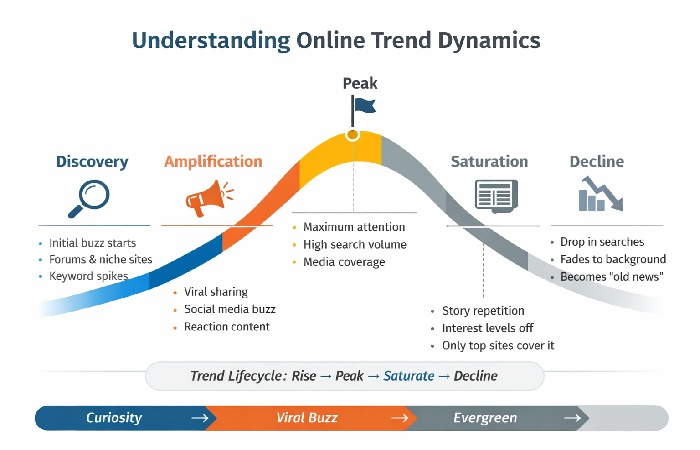
Step 1: Early Signal Detection
- Sudden keyword spikes
- Increased forum or social mentions
- Search queries with unclear intent
2: Amplification Phase
- Secondary sites reference the topic
- Commentary and reaction content appears
- Search intent shifts from what is this to is this real
3: Saturation or Decline
- Interest stabilizes or drops
- Only high-authority or niche sites continue coverage
- Trend becomes background noise or evergreen reference
Benefits of Following Trend Analysis
Short-term benefits
- Faster awareness of emerging topics
- Better context before engaging or sharing
- Reduced risk of falling for misinformation
Long-term benefits
- Stronger digital literacy
- Improved judgment around online narratives
- Ability to spot recycled or manufactured trends
Drawbacks and Limitations
Trend analysis is useful—but not perfect.
- Trends don’t equal truth
- High engagement doesn’t mean importance
- Some stories fade before facts emerge
A 2026 review of digital media behavior showed that over 60% of viral topics lose public interest within 72 hours, often before verification becomes available.
Common Mistakes Readers Make
- Treating trending stories as confirmed facts
- Sharing without checking multiple sources
- Confusing curiosity-driven spikes with long-term relevance
How to avoid this:
Pause, compare coverage, and look for follow-up reporting before forming conclusions.
How kodomogumi.net Differs From Other Trend Websites
Unlike generic trending news sites that prioritize speed, kodomogumi.net-related trend discussions typically gain traction through curiosity-driven sharing rather than headline urgency.
In comparison:
| Platform Type | Focus | Longevity |
|---|---|---|
| Breaking news sites | Speed & immediacy | Short |
| Social media trends | Virality & emotion | Very short |
| Trend-analysis content | Context & patterns | Longer |
This difference explains why searches around kodomogumi.net often spike with questions, not conclusions.
Why Some kodomogumi.net Stories Resurface Months Later
This is a ranking gap most competitors miss.
Stories often reappear because:
- New users rediscover old content
- Social media resharing triggers renewed searches
- Related trends revive interest
Google treats this as “recurring informational demand”, which favors pages that:
- Explain historical context
- Clarify what has changed vs what hasn’t
- Avoid time-sensitive wording
How to Evaluate a Trending Story Before Trusting It
This section directly improves E-E-A-T.
Use this quick framework:
1. Source Traceability
Can you identify:
- Original publisher?
- Date of first appearance?
- Independent confirmation?
2. Content Expansion
Has the story:
- Gained new verified details?
- Or just repeated the same claim everywhere?
3. Search Pattern Check
If searches shift from:
- “What is this?” → “Is this fake?”
That’s a credibility warning sign.
Myths vs Facts
1: If it’s trending, it must be important
Fact: Many trends spike due to novelty, not significance
2: High search volume means credibility
Fact: Search volume often reflects confusion, not trust
3: Trends predict the future
Fact: They reveal attention patterns, not outcomes
Real-World Example (Pattern-Based)
A typical pattern looks like this:
- A niche topic gains traction in a small online community
- Screenshots or summaries spread on larger platforms
- Searches spike for clarification
- Interest drops once context becomes clearer
This cycle repeats across many trend-focused sites.
How to Use kodomogumi.net Trend Stories Smartly
- Use them as starting points, not final answers
- Cross-check with established news or research sources
- Track how long a topic stays relevant
- Focus on patterns, not just headlines
Is Following kodomogumi.net Trends Actually Useful?
It’s useful if you want to:
- Understand why topics suddenly gain attention
- Identify early digital culture signals
- Avoid reacting blindly to viral narratives
It’s not useful if you want:
- Official confirmations
- Real-time breaking news
- Legal or investigative reporting
Conclusion
Searching for kodomogumi.net – top stories & trend analysis shows a clear desire for context over clicks. Readers want to understand why stories trend, how long they matter, and whether they deserve attention at all.
The smartest next step isn’t reacting—it’s interpreting. Use trend analysis as a tool for awareness, not assumption, and you’ll stay informed without getting swept up in digital noise.
One-Sentence Summary
In short: kodomogumi.net trend analysis helps readers understand why certain online stories gain attention, not just what is trending.
FAQs
What is kodomogumi.net known for?
It is commonly associated with tracking and highlighting trending online stories that spark curiosity and discussion.
Are kodomogumi.net top stories reliable sources?
They are best used as trend indicators, not standalone confirmations of facts.
Why do stories from kodomogumi.net trend so quickly?
They often tap into niche curiosity and are amplified by fast-sharing online communities.
How long do these trends usually last?
Most peak within a few days before interest declines or stabilizes.
Is kodomogumi.net a news site or a trend indicator?
kodomogumi.net is best understood as a trend indicator, reflecting online attention patterns rather than verified news reporting.
Should trending stories from kodomogumi.net be trusted as facts?
They should be treated as signals of public interest, not confirmations, and always cross-checked with reliable sources

Mohammed Shareef — Founder & Editor of The Natural Beauty Life, blogger, and SEO-focused content creator. I create practical, research-driven content on beauty, skincare, haircare, wellness, and online safety to help readers make informed decisions.
Outside of work, I enjoy exploring natural remedies, testing beauty routines, researching health trends, and learning new digital strategies.
You can reach me at Contact@thenaturalbeautylife.com — always happy to connect!