
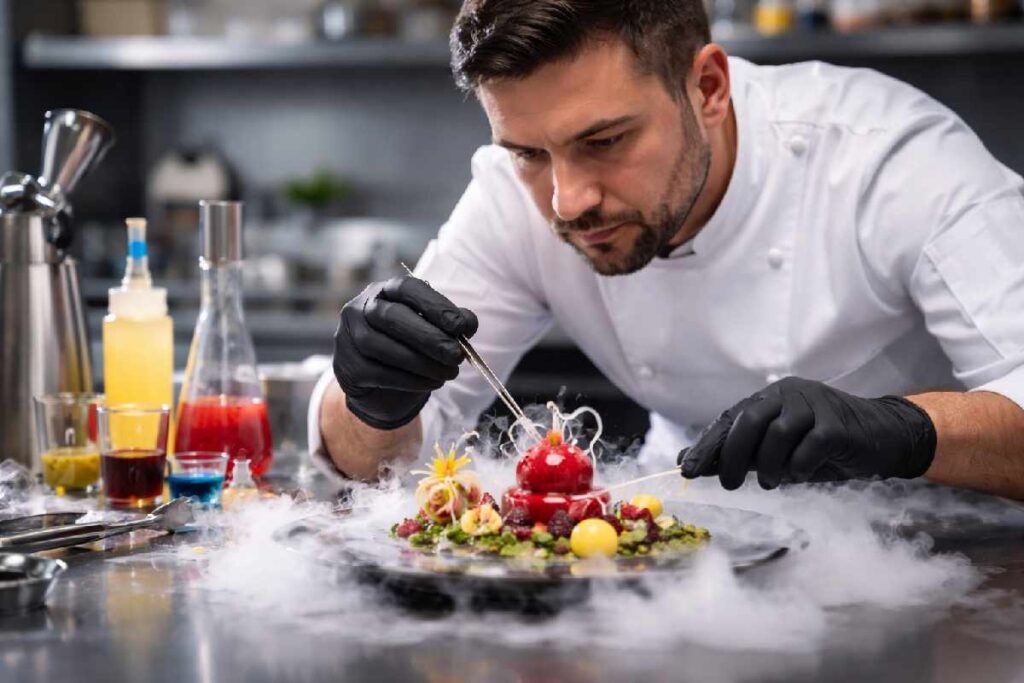
You’ve seen the videos. Desserts that look like caviar bursting with mango flavor. Smoking ice cream created with liquid nitrogen. Edible foams that dissolve on your tongue.
This is molecular gastronomy—and it’s no longer confined to Western fine dining restaurants.
India’s culinary scene is experiencing a quiet revolution. Five-star hotels are adding molecular elements to their menus. Wedding planners are booking chefs who can create Instagram-worthy dessert stations. Food brands need R&D specialists who understand both tradition and innovation.
The question: Can you actually build a career as a molecular gastronomy pastry chef in India?
Yes. But you need the right roadmap.
This guide covers everything from training costs in INR to realistic salary expectations, equipment sourcing, and how Indian chefs can lead this field globally through traditional flavor fusion.
What Is a Molecular Gastronomy Pastry Chef?
A molecular gastronomy pastry chef applies scientific principles to transform traditional desserts into unexpected textures and presentations while maintaining flavor integrity.
The difference from traditional pastry work is fundamental.
Traditional pastry chefs perfect established recipes. They bake flawless croissants, create smooth ganaches, and master sugar work through repetition and technique.
Molecular gastronomy pastry chefs manipulate ingredients at the molecular level. They turn liquids into spheres using chemical reactions. They create foams from solid ingredients. They use precision temperature control to achieve textures impossible through conventional methods.
A traditional chef makes chocolate tart. A molecular chef might deconstruct it into chocolate “soil,” vanilla sphere, and cocoa air—creating new sensory experiences while honoring original flavors.
This requires understanding:
- Chemical reactions between ingredients
- Physical transformations during cooking
- Molecular interactions that create specific textures
The science isn’t intimidating. You don’t need a chemistry degree. But you do need curiosity about why ingredients behave certain ways.
Why Indian Chefs Have a Competitive Edge
Most molecular gastronomy content focuses on Western cuisine. That’s a mistake.
Indian chefs possess advantages unavailable to Western practitioners:
Unique flavor complexity: Cardamom, saffron, rose water, and complex spice blends create aromatic depth Western desserts lack. When you spherify mango kulfi or create cardamom foam, you’re offering something no chef in Paris or New York can authentically replicate.
Untapped market: While molecular gastronomy is mature in Western cities, India represents fresh territory. Competition is lower. Consumer fascination is higher. You can establish yourself as a pioneer rather than fighting for position in saturated markets.
Vegetarian advantage: India’s strong vegetarian culture positions you perfectly for the growing plant-based molecular movement. Many gelling agents like agar-agar are naturally vegan, giving Indian chefs an ethical and technical edge.
Wedding market goldmine: Indian weddings increasingly feature interactive food stations and premium experiences. A molecular dessert station at a luxury wedding can command ₹3-10 lakhs per event—income streams that don’t exist elsewhere.
The fusion of traditional Indian flavors with modern techniques creates opportunities unique to this market.
6 Core Techniques You Must Master
-
Spherification
Spherification encapsulates liquids in thin gel membranes, creating pearls that burst in your mouth.
How it works: Sodium alginate mixed into flavored liquid reacts with calcium bath to form gel membrane. For dairy-based liquids, reverse the process—add calcium lactate to liquid, drop into sodium alginate.
Indian applications:
- Mango kulfi caviar
- Chai concentrate spheres
- Rose water pearls for rasmalai
- Condensed milk spheres
Costs: Sodium alginate ₹800-1,500/kg, calcium lactate ₹600-1,200/kg. Each kilogram produces 40-50 preparations.
Common failures: Spheres break if liquid pH is too acidic (below 3.6). Fix by adjusting pH with baking soda. Irregular shapes happen when dropping from too high—lower your pipette closer to the bath.
-
Foams and Airs
Transform liquids into cloud-like textures that intensify aroma while reducing density.
Key ingredients:
- Soy lecithin (₹400-800/kg): Light, delicate foams
- Gelatin: Stable, mousse-like textures
- Methylcellulose: Heat-stable foams
Indian applications:
- Cardamom air for payasam
- Coffee foam for tiramisu
- Coconut foam replacing cream
- Saffron air garnish
Equipment: Immersion blender (₹1,500-8,000) or whipping siphon with N2O chargers (₹3,500-15,000).
-
Liquid Nitrogen
Flash freezing at -196°C creates unique textures and dramatic presentations.
Safety requirements: Cryogenic gloves (₹800-2,000), goggles, ventilation, proper training.
Indian applications:
- Tableside kulfi preparation
- Frozen fruit powder
- Crystalline meringue
- Smoking effects
Access: Industrial gas suppliers in major cities—Air Liquide India, Linde India, Inox Air Products. Cost: ₹200-400/liter. Most require business registration for purchase.
-
Gelification
Control exact gel firmness using various agents.
Common gelling agents:
Agar-agar (₹300-600/500g): Firm, glossy, heat-stable. Best for fruit gels and transparent elements.
Carrageenan (₹500-900/500g): Very firm, brittle texture for structured shapes.
Gellan gum (₹800-1,400/500g): Extremely firm, heat-stable for gel sheets.
Pectin (₹200-400/500g): Natural, fruit-reactive for traditional preparations.
Indian applications:
- Transparent mango glass
- Coconut milk noodles for falooda
- Rose water gel cubes
- Saffron ribbons
-
Sous Vide
Vacuum-seal ingredients and cook in precisely controlled water baths.
Benefits: Custards never curdle. Chocolate tempers perfectly. Fruit maintains texture. Creams stay consistent.
Equipment costs: Entry-level circulator ₹8,000-12,000. Professional grade ₹18,000-25,000. Vacuum sealer ₹5,000-15,000.
Indian applications: Precise rabri preparation, condensed milk caramelization, controlled fruit infusions.
-
Dehydration
Remove moisture to create intense flavor powders and crispy elements.
Equipment: Dehydrator ₹5,000-20,000, or use home oven on lowest setting.
Indian applications: Saffron powder, dried mango dust, curry leaf crisps, rose petal pieces.
How to Become a Molecular Gastronomy Pastry Chef in India
Step 1: Foundation Training (Year 1-2)
You cannot skip traditional pastry fundamentals. Molecular techniques enhance creativity but don’t replace core skills.
Foundation course options:
Diploma in Bakery & Pastry Arts: 1 year, ₹1.5-3 lakhs. Covers bread, cakes, pastries, chocolate work.
BSc in Culinary Arts: 3 years, ₹4-8 lakhs. Comprehensive culinary education with pastry track.
Advanced Certificate Programs: 6 months, ₹80,000-1.5 lakhs. Intensive pastry-specific training.
Top schools in India:
- Mumbai: APCA (Academy of Pastry and Culinary Arts), ₹2-4L
- Bangalore: Lavonne Academy, ₹1.8-3.5L; IIPC, ₹2.2-3L
- Delhi: IHM Pusa, ₹1.5-2.5L
- Hyderabad: Culinary Academy of India, ₹2-3.5L
Essential foundation skills: Baking science, chocolate tempering, sugar work, laminated doughs, plating, FSSAI certification.
Step 2: Professional Experience (Year 1-3)
Kitchen experience teaches workflow, speed, cost control, and team dynamics that schools can’t.
Where to work:
Five-star hotel pastry kitchens: Taj, Oberoi, ITC, Marriott, Hyatt
Entry positions and salaries:
- Commis pastry: ₹18,000-30,000/month
- Demi chef: ₹35,000-50,000/month
What you’ll learn: High-volume production, cost management, inventory systems, customer preferences, team communication.
Step 3: Molecular Specialization (Year 2-3)
Options in India:
Short workshops (3-7 days): ₹15,000-50,000. International chefs conduct masterclasses at major hotels 2-3 times yearly in Mumbai, Bangalore, Delhi.
Online courses: MasterClass $180/year (~₹15,000), Coursera Harvard “Science & Cooking” (free audit), Udemy courses ₹1,000-5,000.
Self-study: ₹10,000-20,000 for books and starter ingredients. Timeline: 6-12 months home experimentation.
International training (if budget permits):
Spain – Culinary Institute of Barcelona: 4 weeks, ₹8-12 lakhs total
France – Le Cordon Bleu Paris: 3 months, ₹15-25 lakhs total
USA – Culinary Institute of America: 1-2 weeks, ₹3-6 lakhs total
Scholarship opportunities: Ministry of Tourism culinary scholarships, WACS India programs, academy merit-based aid.
Step 4: Build Your Kit
Starter budget (₹10,000-15,000):
- Digital scale 0.1g precision: ₹1,500-3,000
- Basic hydrocolloid pack: ₹2,000-3,000
- Immersion blender: ₹1,500-2,500
- Pipettes and syringes: ₹500-1,000
- Silicone molds: ₹800-1,500
- pH strips: ₹500-2,000
Intermediate (₹50,000-1L):
- Whipping siphon with chargers: ₹8,000-15,000
- Sous vide circulator: ₹12,000-18,000
- Vacuum sealer: ₹8,000-12,000
- Extended ingredient library: ₹5,000-8,000
- Professional thermometer: ₹3,000-5,000
Professional (₹3-5L):
- Liquid nitrogen dewar: ₹40,000-80,000
- Anti-griddle: ₹1.5-2.5 lakhs
- Rotary evaporator: ₹2-3 lakhs
- Commercial dehydrator: ₹25,000-50,000
- Complete ingredient library: ₹15,000-25,000
Where to Buy Equipment and Ingredients
Online suppliers (pan-India):
FabBox (fabbox.in): Molecular gastronomy kits, ₹1,500-8,000, delivery 4-7 days
Amazon India: Search “molecular gastronomy kit,” ₹2,000-15,000, Prime available in metros
Smart Cooking (smartcooking.in): Professional equipment
City-specific local suppliers:
Mumbai: Crawford Market chemical suppliers, Lamington Road equipment, Mulund wholesale baking
Delhi: Chandni Chowk chemical market, Karol Bagh equipment zone, Sadar Bazaar wholesale
Bangalore: Commercial Street baking suppliers, Indiranagar food equipment, Peenya industrial suppliers
Chennai: T. Nagar equipment stores, Parry’s Corner chemicals
Specialized ingredients:
- Sodium alginate: ₹800-1,500/kg
- Calcium lactate: ₹600-1,200/kg
- Soy lecithin: ₹400-800/kg
- Agar-agar: ₹300-600/500g
Liquid nitrogen: Air Liquide India, Linde India, Inox Air Products in major cities. ₹200-400/liter. Requires business registration.
Career Paths and Salary Reality
Most successful molecular gastronomy pastry chefs diversify income across multiple streams. Restaurant salary alone rarely suffices.
Path 1: Restaurant/Hotel Chef
Entry (0-2 years): Commis/Junior Pastry, ₹3-5L annually, Mumbai/Bangalore/Delhi
Mid-level (3-5 years): Chef de Partie/Sous Chef, ₹6-12L annually, includes accommodation and meals
Senior (5-10 years): Executive Pastry Chef, ₹15-30L annually, team management and menu development
Employers: Taj Mahal Palace Mumbai, Oberoi Delhi, ITC Grand Chola Chennai, Leela Ambience Gurugram, experimental standalone restaurants
Path 2: Food R&D Scientist
Food manufacturers need molecular expertise for product development.
Positions: Food Scientist, Culinary Innovation Specialist, Texture Lead
Salary: ₹6-20L annually
Companies: ITC Foods, Britannia, Nestlé India R&D, Amul, Haldiram’s
Advantages: Regular hours, work-life balance, management advancement, international travel
Path 3: Educator
Teaching molecular gastronomy is lucrative in India’s expanding culinary education market.
Opportunities:
- Full-time faculty: ₹40,000-1.2L/month
- Weekend workshops: ₹25,000-75,000 per 2-day session
- Online courses: Passive income potential
- Private classes: ₹3,000-8,000/student/session
Path 4: Event Catering
The wedding market offers highest income potential.
Molecular dessert station pricing:
- 200 guests: ₹50,000-1.5L
- 500 guests: ₹1.5-3L
- 1000+ guests: ₹3-10L
Corporate events: Product launches ₹75,000-2L, celebrations ₹50,000-1.5L
Private dining: 8-10 person dinner ₹25,000-75,000
Two weddings monthly at ₹2L each = ₹48L annual revenue before costs.
Path 5: Content Creator
Income sources:
- Brand partnerships: ₹15,000-2L/post
- YouTube ads: ₹30,000-3L/month at 100k+ subscribers
- Recipe development: ₹25,000-1L/recipe
- Sponsored content
Top creators earn ₹10+ lakhs monthly through combined platforms.
Path 6: Consulting
Services:
- Menu development: ₹50,000-2L/project
- Recipe creation: ₹25,000-1L/recipe
- Food styling: ₹15,000-50,000/shoot
- Staff training: ₹25,000-75,000/program
City-Wise Opportunities
Mumbai: Highest concentration, 40-50 positions annually, 20-30% salary premium, ₹5-35L range
Bangalore: Tech-food fusion, 25-35 positions, ₹4-28L range, startup experimentation freedom
Delhi/NCR: Heritage hotels, strongest wedding market, 20-30 positions, ₹4-30L range
Tier-2 cities: 10-15 positions each, ₹3-20L range, lower living costs enable better lifestyle
Traditional Indian Desserts Transformed
Deconstructed Gulab Jamun
Elements:
- Khoya mousse (whipping siphon espuma)
- Rose water spheres (reverse spherification)
- Cardamom foam (lecithin)
- Sugar syrup glass (isomalt)
Cost per serving: ₹100-120
Selling price: ₹450-650
Profit margin: 70-80%
Works because flavor is familiar while presentation stuns.
Molecular Kulfi
Innovation:
- Traditional kulfi base
- Liquid nitrogen tableside freezing
- Pistachio powder soil (dehydrated)
- Saffron air (lecithin foam)
- Mango caviar topping (spherification)
Universal love for kulfi + premium presentation = menu success.
Modern Rasmalai
Elements:
- Spherified rasgulla centers (calcium alginate)
- Rabri foam (replacing cream)
- Saffron gel sheets (agar-agar)
- Freeze-dried nut garnish
Build at table to showcase transformation.
Molecular Falooda
Layers:
- Rose milk foam (lecithin base)
- Basil seed caviar (spherification)
- Vermicelli gel noodles (agar syringe)
- Ice cream sphere (liquid nitrogen at table)
Perfect for summer menus and wedding stations.
Vegetarian Molecular Pastry Advantage
India’s vegetarian culture positions you for global plant-based trends.
Why it matters: Global shift toward plant-based, ethical concerns, health consciousness
Indian advantages: Agar-agar replaces gelatin naturally. Traditional dairy techniques adapt easily. Vegetable/fruit desserts are cultural norm.
Market positioning: “Vegetarian Molecular Pastry Specialist” has virtually no competition globally.
Reality Check: Challenges and Solutions
Challenge 1: Limited Specialized Training
Reality: Few Indian schools offer comprehensive molecular programs.
Solutions: Hybrid approach (traditional school + online + self-study), international workshops annually, mentorship via LinkedIn/Instagram, accept learning through experimentation.
Challenge 2: Ingredient Sourcing
Reality: Sodium alginate isn’t at local grocery stores.
Solutions: Build supplier relationships in your city, bulk buy with other chefs, use online ordering (FabBox, Amazon), international orders for rare items.
Budget tip: Molecular ingredients have long shelf life. Buy once, use for months.
Challenge 3: Equipment Investment
Reality: Professional setup requires ₹3-5L.
Solutions: Phased purchasing over 1-2 years, shared commercial kitchen spaces, equipment rental, DIY alternatives initially.
Many banks offer small business loans ₹2-10L for culinary equipment.
Challenge 4: Market Education
Reality: Not all diners appreciate molecular gastronomy.
Solutions: Start with subtle applications, educate through menu descriptions, social media previews, fusion approach honoring tradition.
Molecular gulab jamun works better than abstract unfamiliar desserts in tier-2 cities.
Challenge 5: Geographic Limitations
Reality: Opportunities concentrate in metros.
Solutions: Remote consulting/teaching/content, create local demand in tier-2 cities, travel for high-paying wedding gigs, hybrid career model.
Common Mistakes to Avoid
Technical errors:
Not measuring precisely: Eyeballing wastes expensive ingredients. Buy 0.1g precision scale (₹2,000-3,000).
Skipping hydration periods: Hydrocolloids need resting (2-12 hours) to release air bubbles.
Ignoring pH: Acidic liquids fail spherification. Buy pH strips (₹500) or meter (₹2,000).
Wrong temperatures: Heat-sensitive ingredients break gels, collapse foams. Use thermometer.
Career errors:
Abandoning traditional skills: Maintain fundamentals. Balance is crucial.
Too avant-garde too fast: Introduce molecular elements gradually. Read your market.
Not calculating costs: Price at minimum 3x food cost to maintain margins.
Poor customer communication: Train service staff. Write clear menu descriptions.
Learning Resources
Essential books:
“Modernist Cuisine” by Nathan Myhrvold: ₹25,000+ (6-volume set). Comprehensive encyclopedia.
“The Science of Good Cooking” by America’s Test Kitchen: ₹1,500-2,000. Perfect for beginners.
“On Food and Cooking” by Harold McGee: ₹800-1,200. Best for understanding ingredient chemistry.
“Molecular Gastronomy” by Hervé This: ₹1,000-1,500. Scientific foundation.
Where to buy: Amazon India, Flipkart, public libraries in metros, culinary school libraries.
Free online resources:
YouTube: ChefSteps (professional techniques), Guga Foods (experimentation), How To Cook That (molecular pastry)
Coursera: Harvard “Science & Cooking” (free audit, certificate ₹4,000)
MasterClass: Various chefs ($180/year, ~₹15,000 unlimited access)
Communities:
Indian Culinary Forum (ICF) professional association
Facebook: “Pastry Chefs India,” “Indian Bakers Forum”
Reddit: r/AskCulinary, r/Cooking
WhatsApp/Telegram: City-based chef networks
Competitions:
Young Chef Olympiad, India International Culinary Classic (IICC), WACS India events, Instagram challenges
Famous Chefs to Study
Global pioneers:
Ferran Adrià (Spain): El Bulli legacy, deconstructivist approach, spherification popularization. Study his books and “El Bulli: Cooking in Progress” documentary.
Heston Blumenthal (UK): The Fat Duck (3 Michelin stars), multi-sensory dining, liquid nitrogen ice cream. Watch “Heston’s Feasts” series.
Grant Achatz (USA): Alinea (consistent top 10 globally), edible balloons, interactive plating. Read “Life, on the Line.”
Indian practitioners:
Manu Chandra (Bangalore): Toast & Tonic, Monkey Bar. Subtle molecular elements in contemporary Indian cuisine. Instagram @chefsanchez
Ranveer Brar (Mumbai): Modernizing traditional Indian sweets. Instagram @ranveerbrar
Himanshu Saini (Dubai/formerly India): Contemporary Indian fine dining. Study Tresind Dubai menu.
The scarcity of Indian practitioners means you can be among the pioneers.
Month-by-Month Action Plan
Month 1-3:
Week 1-2: Watch 10 molecular videos, read “Science of Good Cooking,” join 3 culinary groups, follow 20 molecular chefs
Week 3-4: Research schools, calculate budget, create savings plan, try first foam experiment (₹500)
Month 2: Attend school open houses, connect with chefs on LinkedIn, start Instagram portfolio, buy starter kit (₹2,000-3,000)
Month 3: Enroll in foundation course or online molecular course, purchase basic equipment, practice spherification
Month 4-12:
Foundation training: Master traditional pastry, weekend molecular practice, build Instagram (1-2 posts weekly), network with innovative classmates
Working professionals: 5-10 hours weekly practice, gradual equipment investment, propose molecular menu elements, document experiments
Year 2:
Q1: Attend first workshop, connect with suppliers, develop 5 signatures, start part-time molecular work
Q2: Build equipment collection (₹50k-1L invested), create portfolio (15-20 creations), enter competition, launch side income
Q3-4: Pursue full-time molecular position, consider international training, build 50+ connections, establish online presence
Year 3-5:
Position as specialist in your city, diversify income (restaurant + teaching + events + content), mentor juniors, consider business ownership, target ₹10-25L through multiple streams
FAQs
How long does it take to become a molecular gastronomy pastry chef?
Most people take 3–5 years, including 1–2 years of foundational pastry training, 6–12 months of molecular specialization, and 2–3 years of professional experience. You can start using basic techniques within weeks.
Do I need a science degree?
No, a science degree isn’t required. Basic food science can be learned through culinary courses, books, and online resources, then reinforced through practice.
What is the realistic starting salary in India?
Entry-level roles in metro cities usually start around ₹3–5L per year. With side income from teaching, events, or content, some chefs reach ₹6–10L in their first years.
Is molecular gastronomy expensive to practice?
You can start home experiments with a basic kit from about ₹10,000, while professional setups can reach ₹3–5L. Higher ingredient costs are often balanced by premium pricing for unique desserts.
Can I learn molecular gastronomy entirely online?
You can learn theory and see demonstrations online, but hands-on practice with equipment is essential. A hybrid path—online learning plus in-person workshops or mentorship—works best.
What’s the job market like in India?
The market is small but growing, especially in metro cities where high-end restaurants and hotels experiment more. Many chefs combine molecular skills with traditional pastry roles or independent projects.
Is molecular gastronomy safe?
Yes, when you use food‑grade ingredients correctly and follow safety guidelines. Extra care is needed with tools like liquid nitrogen, which require proper training and protective gear.
Can vegetarians practice molecular gastronomy?
Absolutely. Many techniques use plant-based ingredients, and gelling agents like agar‑agar are vegan alternatives to gelatin, making this field very friendly to vegetarian chefs.
CONCLUSION
The fusion of India’s rich culinary heritage with molecular gastronomy techniques creates opportunities unavailable anywhere else globally. While Western chefs popularized spherification and foams, Indian chefs can perfect cardamom clouds, mango kulfi spheres, and deconstructed gulab jamun that honor tradition while pushing boundaries.
This molecular gastronomy pastry chef career requires investment in training, equipment, and continuous learning. The job market is niche, with limited pure molecular positions. But this scarcity creates less competition and higher demand for skilled professionals bridging traditional excellence and scientific innovation.
Your competitive advantage lies in traditional flavor fusion, vegetarian molecular expertise, lower emerging market competition, and multiple income potential reaching ₹10-30+ lakhs through diversification across restaurants, teaching, events, and content creation.
The pioneers establishing molecular gastronomy pastry in India over the next 3-5 years will become industry leaders for decades. Start your journey today. Master one technique this month. Build your kit over six months. Launch your first molecular dessert within a year. India’s pastry revolution is beginning—be among the innovators shaping its future as a molecular gastronomy pastry chef.