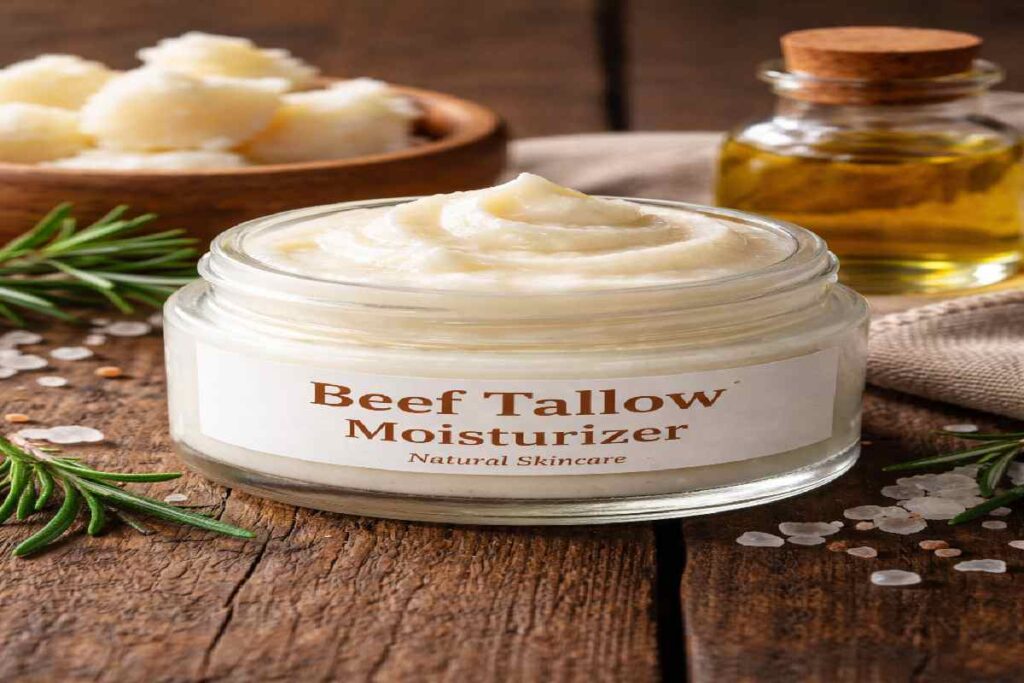
Beef tallow moisturizer works best as a barrier-repair occlusive for very dry or compromised skin—but it is not a universal moisturizer and can worsen acne-prone or humid-climate skin.
Many people discover beef tallow through “ancestral skincare” claims that promise fewer chemicals and better skin. The problem? Most explanations skip how skin actually works. That leads to people using tallow incorrectly—and blaming their skin when it breaks out.
Here’s the direct answer: beef tallow can help if your skin barrier is damaged and dry. It can hurt if your skin already produces oil or lives in humidity. The difference is understanding function, not following trends.
Key Takeaways
- Beef tallow is an occlusive, not a full moisturizer
- Excellent for very dry, compromised skin barriers
- Can clog pores on acne-prone skin
- Works best layered over hydration
- Quality and sourcing matter more than hype
What Is Beef Tallow Moisturizer?
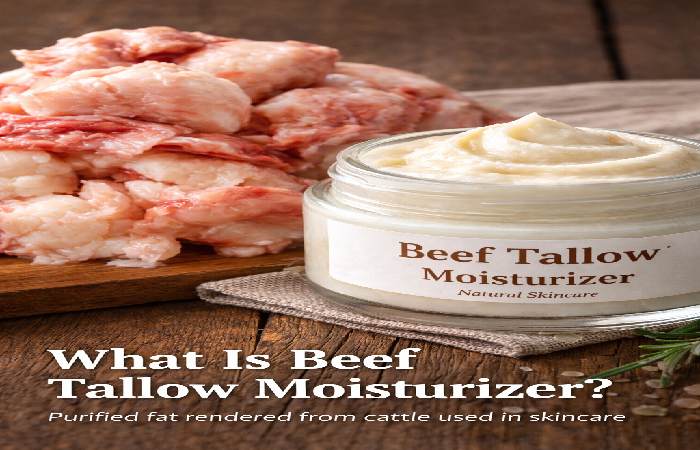
Beef tallow is purified animal fat rendered from cattle, traditionally used for cooking, candles, and soap. In skincare, it’s whipped into balms or creams and marketed as “skin-identical.”
That phrase is partially true—but incomplete.
Yes, tallow contains fatty acids found in human sebum. No, that does not mean it behaves like modern moisturizers designed for diverse skin types.
How Beef Tallow Works on Skin
Beef tallow functions primarily as an occlusive.
That means:
It seals moisture in
It does not add water
It does not actively repair skin cells
If you apply it to dry skin without hydration underneath, it simply locks in dryness.
Dermatology organizations like the American Academy of Dermatology consistently explain that effective moisturization requires:
Water (hydration)
Lipids (barrier support)
Occlusion (moisture retention)
Beef Tallow Moisturizer Benefits (What Actually Improves — and What Doesn’t)
It provides functional skin barrier benefits, not universal skin improvement. Most benefits come from occlusion, not active skin repair.
Real Benefits
- Seals moisture loss in severely dry skin
- Softens cracked or over-exfoliated areas quickly
- Reduces tightness caused by barrier disruption
- Works well for hands, heels, elbows, and winter skin
Benefits People Expect (But Often Don’t Get)
- Acne reduction
- Skin brightening
- Oil balance
- Hydration without layering
Key insight:
Beef tallow improves how skin feels, not how skin functions long-term.
Beef Tallow Moisturizer Review
Beef tallow reviews are either extremely positive or strongly negative — rarely neutral.
Why Some People Love It
- Immediate softness
- Relief from extreme dryness
- Minimalist, “natural” appeal
And Others Hate It
- Breakouts after 3–7 days
- Heavy, greasy feel
- Odor development over time
- Poor performance in warm weather
The reviews conflict:
Most users don’t account for skin type + climate + layering method.
Real Benefits: When Beef Tallow Helps
Beef tallow can be useful in specific conditions:
Very Dry or Barrier-Damaged Skin
- Post-over-exfoliation
- After retinoid irritation
- Cracked hands, heels, elbows
Cold or Arid Climates
- Winter environments
- High altitude dryness
Minimalist Routines
People intolerant to preservatives or fragrances
Example scenario:
Someone with over-exfoliated skin applies a humectant serum, then seals it with a thin layer of tallow at night. Barrier recovers in days—not weeks.
Risks, Downsides & Who Should Avoid It
Beef tallow fails in these cases:
Acne-Prone or Oily Skin
High occlusivity traps sebum
Increases comedone risk
Fungal Acne
Fatty acid profile may feed Malassezia
Hot & Humid Climates
- Traps sweat
- Feels heavy and greasy
Poor-Quality Formulations
- Oxidation causes odor and irritation
- Essential oils increase sensitivity
Beef Tallow vs Other Moisturizers
| Option | Best For | Downsides |
|---|---|---|
| Beef tallow | Extreme dryness | Heavy, pore-clogging |
| Petrolatum | Medical barrier repair | No nutrients |
| Shea butter | Dry-normal skin | Can feel waxy |
| Ceramide creams | Long-term barrier health | Less “natural” |
Bottom line: Ceramide-based creams outperform tallow for daily facial use.
How to Use Beef Tallow Correctly
Correct method:
- Apply to damp skin
- Use after a humectant (glycerin, aloe, hyaluronic acid)
- Night-time use only for face
- Patch test for 48 hours
Do not:
- Use as your only moisturizer
- Apply thick layers on oily skin
- Use in summer humidity
Buying & Quality Checklist
Look for:
- Grass-fed sourcing
- Low-heat rendering
- No essential oils
- Opaque packaging
Avoid:
- Strong odor
- Yellow/brown discoloration
- “Cures everything” claims
Is Beef Tallow Moisturizer Right for You?
Good fit if you:
Have very dry skin
Live in a cold climate
Prefer occlusive balms
Skip it if you:
Break out easily
Sweat a lot
Want a lightweight daily moisturizer
Beef Tallow Moisturizer for Dry Skin (Best-Case Use)
Beef tallow works best for dry skin, not dehydrated skin.
It Works Well If You Have:
- Flaky or cracking skin
- Barrier damage from exfoliants or retinoids
- Cold or low-humidity exposure
It Works Poorly If:
- Skin feels tight but produces oil
- Breakouts occur easily
- You live in humid conditions
Best Routine for Dry Skin
- Apply a humectant (glycerin, aloe, hyaluronic acid)
- Light moisturizer (optional)
- Thin layer of beef tallow as final step (night only)
Beef Tallow for Skin in India (Climate & Practical Reality)
In most parts of India, beef tallow is not suitable as a daily facial moisturizer.
Why It’s Challenging in India
- Hot and humid climate increases sweat trapping
- Occlusives raise acne risk
- Limited high-quality sourcing
- Faster oxidation due to heat
How It Can Be Used in India
- Spot treatment for cracked areas
- Night use in dry winter regions
- Body use over damp skin
Verdict:
In Indian climates, beef tallow works better as a targeted balm, not a daily face cream.
Beef Tallow Moisturizer in India – Price, Access & Smarter Alternatives
Availability & Price (Illustrative)
| Country | Availability | Price Range (50g) |
|---|---|---|
| India | Limited | High |
| USA | High | Moderate |
| UK | Moderate | Moderate |
| Australia | Limited | High |
| Canada | Moderate | Moderate |
Luminance Beef Tallow Balm – What to Know Before Buying
Luminance Beef Tallow Balm is often searched by users comparing branded options.
Consider Before Buying
- Suitable for: very dry, non-acne-prone skin
- Not ideal for: oily or breakout-prone users
- Texture: heavy, balm-like
- Value: depends on sourcing transparency
Buying tip:
Judge by formulation quality — not influencer claims.
Common Mistakes When Using Beef Tallow on Skin
Avoid these errors to prevent breakouts and irritation:
- Using beef tallow as the only moisturizer
- Applying on completely dry skin
- Using thick layers on the face
- Using daily in humid weather
- Ignoring patch testing
Conclusion: Is Beef Tallow Moisturizer Worth Using?
Beef tallow moisturizer is neither a skincare miracle nor a gimmick. It is a highly occlusive fat that can be genuinely helpful for very dry, barrier-damaged skin, especially in cold or low-humidity conditions. Used correctly—over hydrated skin and in thin layers—it can reduce moisture loss and improve skin comfort.
However, beef tallow is not suitable for everyone. For acne-prone, oily, or humidity-exposed skin, it often causes congestion and breakouts. In warm climates like much of India, it performs better as a targeted balm for cracked areas than as a daily facial moisturizer.
FAQs
1. Is beef tallow moisturizer good for your face?
It can help very dry or damaged skin but may clog pores on acne-prone faces.
2. Does beef tallow clog pores?
Yes, it can—especially for oily or acne-prone skin types.
3. Is beef tallow better than petroleum jelly?
Not necessarily. Petroleum jelly is more stable and less comedogenic.
4. Can beef tallow help eczema?
It may reduce dryness but does not treat inflammation or triggers.
5. Can you use beef tallow every day?
Only if your skin tolerates heavy occlusives and you layer it properly.
6. Is beef tallow safe for sensitive skin?
Sometimes—but poor sourcing or oxidation can cause irritation.
7. Does beef tallow expire?
Yes. Oxidation occurs within months without proper storage.

Mohammed Shareef — Founder & Editor of The Natural Beauty Life, blogger, and SEO-focused content creator. I create practical, research-driven content on beauty, skincare, haircare, wellness, and online safety to help readers make informed decisions.
Outside of work, I enjoy exploring natural remedies, testing beauty routines, researching health trends, and learning new digital strategies.
You can reach me at Contact@thenaturalbeautylife.com — always happy to connect!