
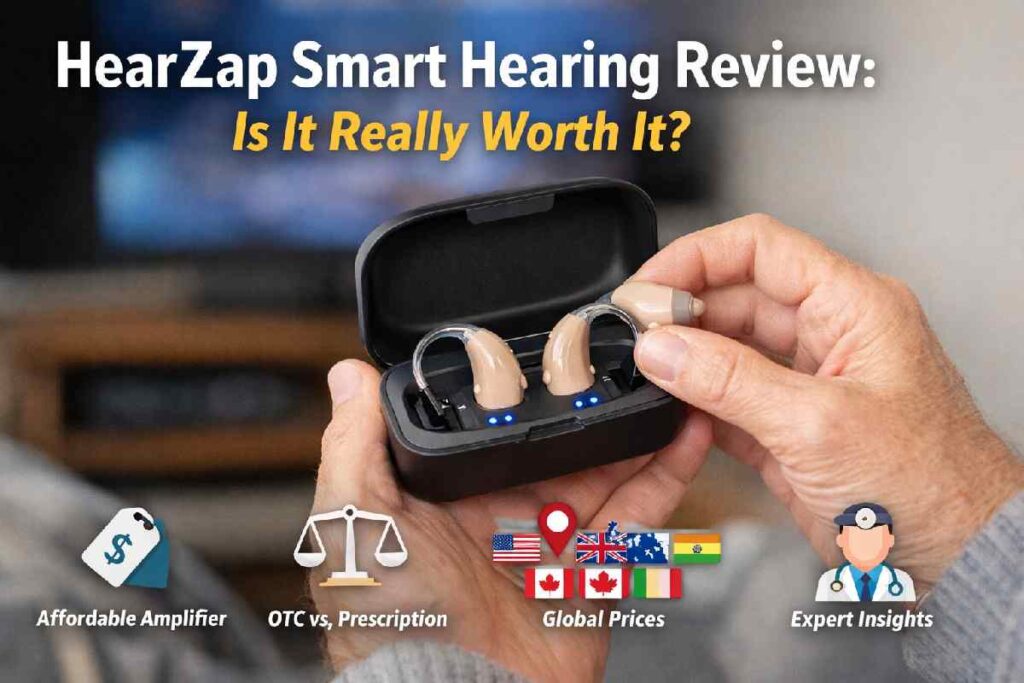
Introduction
HearZap Smart Hearing is best understood as an affordable sound-amplification device for mild hearing difficulty—not a replacement for medically prescribed hearing aids.
If you’re struggling to hear conversations clearly, the idea of spending thousands on traditional hearing aids can feel overwhelming. That frustration is exactly where products like HearZap step in. The problem is not whether HearZap works at all—it’s whether it works for you. Many buyers don’t know the difference between a medical hearing aid and a consumer amplifier, and that confusion leads to disappointment. This review clears that up fast and helps you decide realistically.
Key Takeaways
-
HearZap amplifies sound; it does not medically correct hearing loss
-
Best for mild, situational hearing difficulty
-
Much cheaper than prescription hearing aids
-
Limited customization and noise filtering
-
Not suitable for severe or worsening hearing loss
What Is HearZap Smart Hearing?
HearZap Smart Hearing is an over-the-counter (OTC) sound amplification device designed to make everyday sounds louder. It is marketed toward older adults and first-time users who want a simple, budget-friendly solution without doctor visits.
The key thing most competitors don’t explain: HearZap is not a regulated medical hearing aid. That doesn’t make it useless—but it does define its limits.
How HearZap Smart Hearing Actually Works
Unlike prescription hearing aids that analyze frequencies and adapt to your hearing profile, HearZap works by:
-
Capturing surrounding sound through a microphone
-
Amplifying it uniformly
-
Delivering it into the ear via an in-ear device
The “smart” aspect usually refers to:
-
Rechargeable battery
-
Volume control
-
Compact, discreet design
There is no audiogram-based tuning, which is where the price difference comes from.
Real-World Use Cases: When It Helps (and When It Doesn’t)
Works well if you:
-
Struggle to hear TV dialogue
-
Miss parts of one-on-one conversations
-
Need occasional amplification at home
Struggles if you:
-
Are in noisy restaurants or crowds
-
Have tinnitus or uneven hearing loss
-
Experience rapid or severe hearing decline
This is where many negative reviews come from—people expect clinical performance from a consumer device.
HearZap Smart Hearing: Pros and Cons
Pros
-
Significantly lower cost than prescription aids
-
No hearing test required
-
Easy to use for beginners
-
Rechargeable and portable
Cons
-
No frequency-specific tuning
-
Limited noise reduction
-
Can amplify unwanted background noise
-
Not suitable for medical hearing conditions
Competitive Comparison: Countries, Brands & Pricing
Country-Wise Availability & Price Range
| Country | Availability | Avg Price Range | Support Quality |
|---|---|---|---|
| USA | High | $90–$150 | Moderate |
| UK | Medium | £80–£130 | Moderate |
| Canada | Medium | CAD 120–180 | Moderate |
| Australia | Limited | AUD 140–220 | Low |
| India | Growing | ₹3,500–6,000 | Low–Moderate |
Brand Comparison (OTC Segment)
| Brand | Device Type | Custom Tuning | Target User |
|---|---|---|---|
| HearZap | Amplifier | No | Beginners |
| Sony OTC | Amplifier+ | Limited | Tech-friendly users |
| Eargo | Medical-grade OTC | Yes | Moderate loss |
| Lexie | Audiologist-backed | Yes | Long-term users |
| Beurer | Amplifier | No | Occasional use |
Specialist Reviews: What Experts Actually Say
Most audiologists agree on three points:
-
Devices like HearZap are fine as a first step, not a final solution
-
They help users recognize hearing issues early
-
Delaying professional diagnosis for severe loss is risky
Experts typically recommend HearZap only for mild or situational difficulty, not diagnosed hearing impairment.
Is HearZap Smart Hearing Worth Buying?
Buy HearZap if:
-
You want an affordable trial option
-
Your hearing issues are mild
-
You understand its limitations
Skip HearZap if:
-
You’ve failed a hearing test
-
You experience ringing or distortion
-
You need long-term correction
Think of HearZap as reading glasses—not prescription lenses.
How HearZap Smart Hearing Compares to Prescription Hearing Aids
One of the biggest points of confusion for buyers is assuming HearZap competes directly with prescription hearing aids. In reality, they serve very different needs.
Prescription hearing aids are:
-
Custom-programmed using an audiogram
-
Tuned to specific frequency losses
-
Designed for long-term, daily medical use
HearZap Smart Hearing, by contrast:
-
Amplifies all sounds equally
-
Has no medical calibration
-
Is intended for short-term or situational assistance
This distinction matters because users with moderate to severe hearing loss often feel disappointed—not because HearZap “fails,” but because it was never designed for that level of correction.
Conclusion
HearZap Smart Hearing makes sense when it’s judged for what it truly is—not as a medical hearing aid, but as an entry-level sound amplification tool. For people with mild hearing difficulty, occasional listening challenges, or hesitation about committing to expensive prescription devices, it offers a low-risk way to improve daily communication.
FAQs
Is HearZap Smart Hearing FDA approved?
It is typically sold as an OTC sound amplifier, not a regulated prescription hearing aid.
Can HearZap replace hearing aids?
No. It amplifies sound but does not medically correct hearing loss.
Who should use HearZap?
People with mild hearing difficulty or first-time users exploring options.
Does HearZap work for severe hearing loss?
No. Severe or progressive loss requires professional diagnosis.
Is HearZap good for elderly users?
Yes, if hearing loss is mild and the user prefers simple controls.
Does it reduce background noise?
Only minimally. It mainly increases overall volume.
How long does the battery last?
Typically one day of regular use per charge.
Is HearZap available worldwide?
Availability and support vary by country.
Can wearing HearZap damage hearing?
Excessive volume over long periods can cause discomfort—moderation matters.
Should I get a hearing test before buying?
Yes, especially if symptoms are persistent or worsening.