
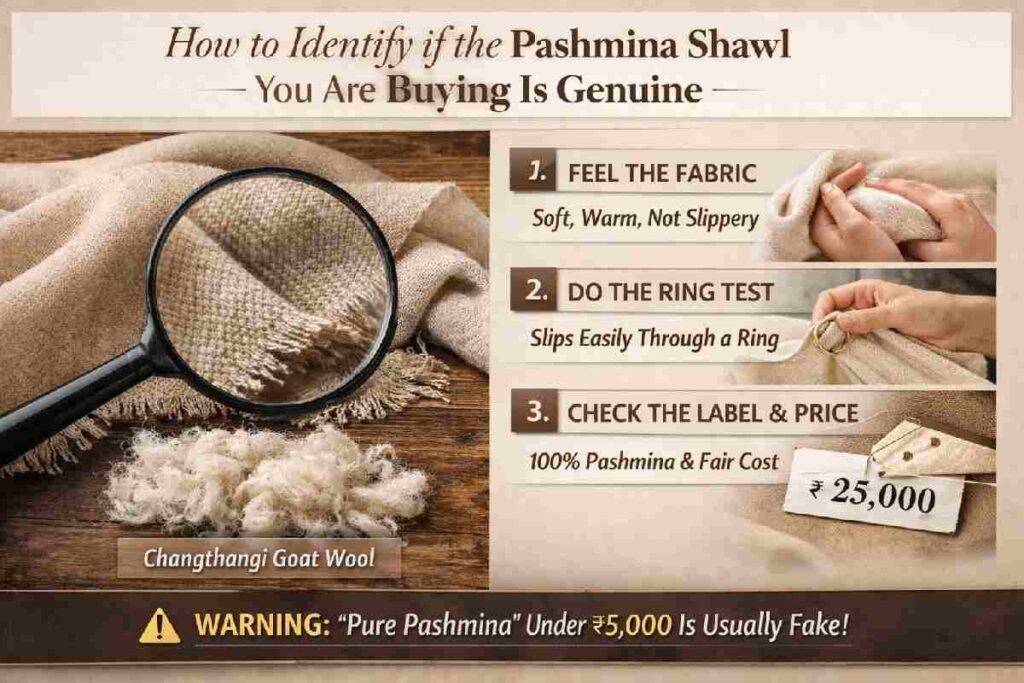
Buying a pashmina shawl should feel special—but for many buyers, it feels confusing instead. Prices range from a few thousand to over a lakh, labels are often unclear, and countless products sold as “pashmina” are actually blends or synthetic imitations.
So, how do you identify if the pashmina shawl you are buying is genuine, especially in India where the term is widely misused?
Genuine pashmina is rare, handmade, and crafted from the ultra-fine undercoat of the Changthangi goat found in Ladakh. Because of its scarcity and craftsmanship, it has very specific qualities that fake or blended shawls simply cannot replicate.
This guide explains exactly how to spot real pashmina using simple, practical checks—from fabric feel and weave inspection to price comparison and labeling—so you can buy with confidence, whether shopping online or in person.
Key Takeaways
- Pure pashmina in India is expensive by nature due to limited Changthangi goat wool and hand craftsmanship—low prices usually mean blends or synthetics.
- A genuine pashmina shawl feels lightweight, warm, breathable, and matte, never shiny or stiff.
- No single test proves authenticity—use multiple checks together: feel, weave, warmth, breathability, and price.
- Labels and GI tags can support authenticity, but touch, texture, and seller transparency matter more.
- Shawls priced below ₹5,000 in India are almost never pure pashmina, regardless of how they are marketed.
- Buying from sellers who clearly disclose fiber content, origin, and weaving method greatly reduces the risk of fakes.
What Is Genuine Pashmina? (Clear Definition)
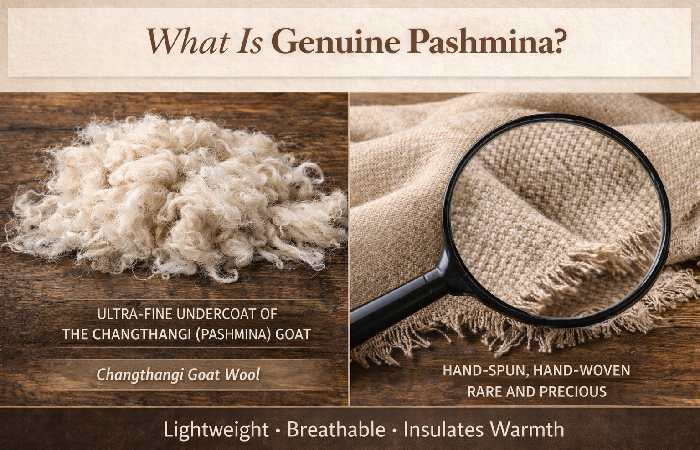
Genuine pashmina is made from the ultra-fine undercoat of the Changthangi (Pashmina) goat, native to the high-altitude Ladakh region of India.
Key facts you should know:
- Fiber thickness: 12–16 microns (much finer than cashmere)
- Naturally breathable and insulating
- Traditionally hand-spun and hand-woven
- Scarce raw material → higher price
If a shawl contains viscose, polyester, acrylic, silk blends, or machine weaving, it is not pure pashmina.
Who This Guide Is For
This article is useful if you are:
- Buying your first pashmina shawl
- Shopping online and unsure what’s real
- Comparing prices and confused by “cashmere vs pashmina”
- Looking for a long-term investment shawl
- Buying a meaningful gift and want authenticity
Who Should Be Extra Cautious
You should slow down and verify carefully if:
- The price feels too low to be realistic
- The seller avoids stating fiber composition
- The shawl looks shiny, stiff, or overly smooth
- The product description uses vague terms like “pashmina-style” or “pashmina feel”
1. Feel the Fabric (The Softness Test)
Genuine pashmina feels:
- Soft but not slippery
- Warm immediately on contact
- Slightly textured, not silky-smooth
Red flags:
-
Cold touch
-
Plastic-like smoothness
-
Crunchy or stiff feel
Synthetic blends often imitate softness but lack warmth and breathability.
2. Check the Weight (Light but Warm)
Pure pashmina is surprisingly lightweight.
A large shawl should:
-
Feel almost weightless in your hands
-
Still provide strong warmth when worn
Heavy shawls often contain silk or synthetic fibers.
3. Do the Ring Test (In-Store Tip)
Try passing the shawl through a ring:
-
Genuine pashmina slips through easily
-
Thick blends or synthetics usually don’t
This works because authentic fibers are extremely fine.
4. Inspect the Weave Closely
Look carefully at the weave:
-
Slight irregularities = handwoven authenticity
-
Perfect, uniform weave = machine-made
Hand-woven pashmina is never factory-perfect.
5. Examine the Shine (Matte vs Glossy)
Genuine pashmina has a soft, matte appearance.
Avoid shawls that:
-
Look shiny under light
-
Reflect like silk or polyester
Natural wool fibers diffuse light rather than reflect it.
6. Read the Label Carefully (But Don’t Trust It Blindly)
What to look for:
-
“100% Pashmina” or “100% Changthangi wool”
-
Country of origin: India (Ladakh/Kashmir)
Be cautious of:
-
“Pashmina blend”
-
“Pashmina wool feel”
-
No fiber percentage listed
Labels can be misleading—use them as supporting evidence, not proof.
7. Price Reality Check (Very Important)
As of recent years:
-
Pure pashmina shawls rarely sell cheaply
-
Handmade production + limited fiber = higher cost
If a “pure pashmina” shawl is priced like fast fashion, it’s almost certainly not genuine.
8. Breathability Test (Real-World Use)
Wear the shawl indoors for a few minutes:
-
Genuine pashmina keeps you warm without overheating
-
Synthetics trap heat and feel suffocating
This difference becomes obvious with wear.
Common Myths vs Facts
| Myth | Reality |
|---|---|
| All soft shawls are pashmina | Many synthetics are soft but not breathable |
| Cashmere and pashmina are the same | Pashmina is finer and rarer |
| Burn test is reliable | Unsafe and unreliable |
| GI tag guarantees quality | Helpful, but not foolproof |
| Shine means luxury | Shine often means synthetic fibers |
Benefits and Drawbacks of Genuine Pashmina
Benefits
- Exceptional warmth without bulk
- Long lifespan when cared for properly
- Timeless style, not trend-dependent
- Naturally breathable and skin-friendly
Drawbacks
- Higher upfront cost
- Requires gentle care (hand wash or dry clean)
- Easily damaged by rough handling
Common Mistakes Buyers Make
- Trusting price over material facts
- Confusing “pashmina blend” with pure pashmina
- Ignoring weave and texture
- Buying from sellers who avoid transparency
Avoiding these mistakes alone eliminates most fakes.
Practical Buying Tips (Online & Offline)
- Ask sellers exact fiber composition
- Look for clear product photos showing weave detail
- Avoid overly polished marketing language
- Prefer sellers who explain sourcing and craftsmanship
- Read reviews focusing on feel and warmth, not just looks
Conclusion
Knowing how to identify if the pashmina shawl you are buying is genuine comes down to combining simple checks rather than trusting labels alone. A real pashmina is lightweight yet warm, breathable, softly textured, and realistically priced—never shiny, stiff, or suspiciously cheap.
In India, genuine pashmina reflects the rarity of Changthangi goat wool and the skill of hand-spinning and hand-weaving, which is why price, feel, weave, and seller transparency must always be evaluated together. No single test is enough, but when multiple signs align, authenticity becomes clear.
FAQ
How can I tell if a pashmina shawl is real at home?
Check softness, warmth, breathability, weave irregularities, and realistic pricing together—no single test is enough alone.
Is cashmere the same as pashmina?
No. Pashmina comes from a specific goat breed and is finer and rarer than standard cashmere.
Are cheap pashmina shawls ever genuine?
Extremely rare. Low prices usually indicate blends or synthetics.
Does a GI tag guarantee authenticity?
It helps, but physical characteristics and seller transparency still matter.
Can pashmina be blended and still be good quality?
Blends can be pleasant, but they are not pure pashmina and should be priced accordingly.