
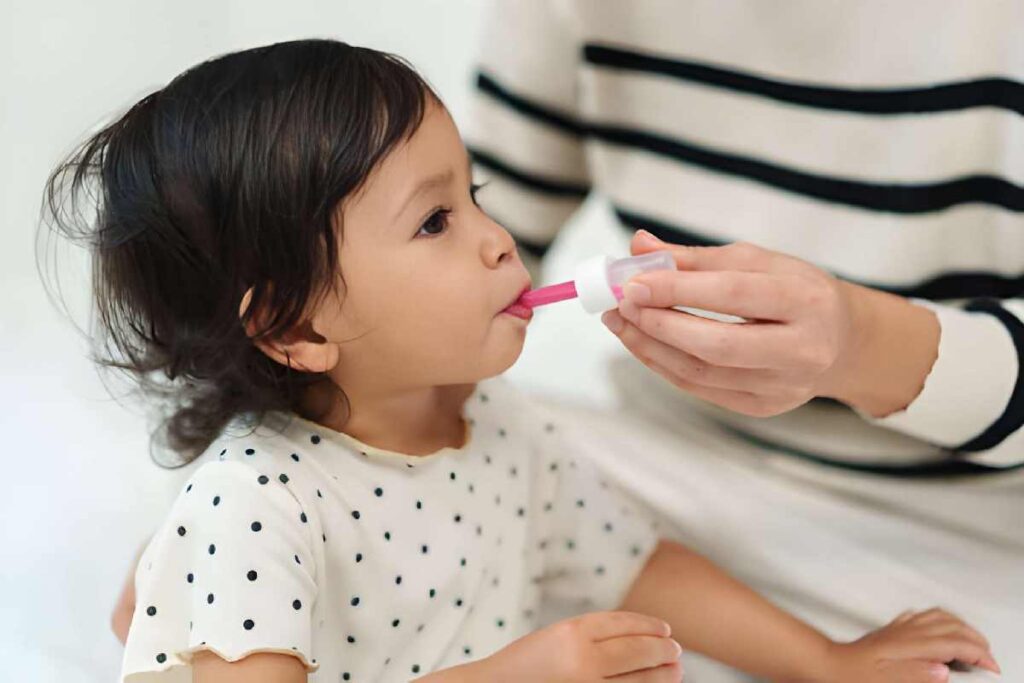
What Actually Are Mylicon Gas Drops?
Mylicon gas drops are an over-the-counter medication designed specifically for infant gas relief. The active ingredient is simethicone, which sounds fancy but really just breaks up gas bubbles in your baby’s tummy.
Here’s what makes them different from other remedies:
- Fast-acting – They work within minutes, not hours
- Safe for newborns – You can use them from day one
- Non-systemic – They don’t get absorbed into your baby’s bloodstream
- Dye-free options – Because some babies react to dyes
I remember standing in the pharmacy aisle at 2 AM (because of course that’s when the gas pain hit hardest), trying to read tiny labels with exhausted eyes. Simethicone was the one ingredient that kept coming up as pediatrician-recommended.
How Do These Gas Relief Drops Actually Work?
The science is surprisingly simple. Simethicone is an anti-foaming agent. Think about what happens when you add dish soap to a sink full of bubbles – they pop and disappear, right?
That’s basically what happens in your baby’s digestive system with mylicon gas drops. The medication breaks surface tension on gas bubbles, allowing them to combine into larger bubbles that are easier for your baby to pass through burping or, well, the other way.
What simethicone doesn’t do is prevent gas from forming in the first place. It’s purely reactive – meaning it helps with gas that’s already there causing discomfort.
The Reality Check
I’m not going to tell you these drops are magic. Some nights they worked within 10 minutes. Other nights, we still had a fussy baby for another hour. Every kid is different, and gas pain can come from multiple sources.
When Should You Use Infant Gas Drops?
I started recognizing the signs pretty quickly once I knew what to look for. My daughter would:
- Pull her knees up to her chest repeatedly
- Arch her back while crying
- Turn red in the face
- Have a hard, distended belly
- Struggle to pass gas or seem uncomfortable doing so
- Cry more intensely after feeding
The best time to give mylicon gas drops is right after feeding, or when you first notice the symptoms starting. Some parents give them before every feeding as a preventive measure, though our pediatrician suggested using them as needed instead.
I tried both approaches. Giving them proactively seemed wasteful when some days my baby had zero gas issues. But having them ready the second I saw those telltale signs? That made all the difference.
Dosage and Safety Information You Need to Know
Here’s what matters most about mylicon gas drops dosage:
- Infants and children under 2 years: Typically 0.3 mL (20 mg) as needed, up to 12 times per day
- Can be mixed with formula, water, or breast milk (though I found giving it straight was faster)
- Always follow the specific product instructions since concentrations can vary
The drops come with a graduated dropper that makes measuring easy. I kept one bottle in the diaper bag and one next to the changing table because scrambling to find them during a gas attack was not fun.
Important Safety Notes
- You can’t really overdose on simethicone – excess just passes through
- Still, stick to recommended dosages because why use more than needed?
- Mylicon gas drops are generally safe but talk to your pediatrician if your baby is premature or has other health conditions
- If symptoms persist beyond a few days or worsen, that’s a doctor visit
I’m all about not freaking out, but persistent gas pain can sometimes signal food allergies, lactose intolerance, or other digestive issues that need professional attention.
Mylicon vs. Other Gas Relief Options
The baby gas relief market is crowded. Here’s how mylicon gas drops compare to alternatives I tried:
Gripe Water
Contains various herbs and sometimes sodium bicarbonate. I tried this first, actually. It helped with hiccups but didn’t touch the gas pain our daughter experienced. Some parents swear by it though.
Probiotic Drops
These help with overall gut health and can reduce gas over time. We used probiotics alongside mylicon gas drops – the probiotics for long-term prevention, mylicon for immediate relief.
Gas Relief Through Diet Changes
If you’re breastfeeding, eliminating dairy, caffeine, or cruciferous vegetables might help. I cut dairy for three weeks and saw some improvement, but I still needed the drops on hand.
The Windi
This is a tube you insert to help release gas. Works but feels more invasive than drops. We kept it as a last resort option.
Mylicon gas drops became my go-to because they’re non-invasive, work relatively fast, and don’t require me to change my entire diet or insert anything anywhere.
Real Talk: Do Mylicon Gas Drops Always Work?
Sometimes, yes. Sometimes, no. Sometimes, maybe?
I’d say they provided noticeable relief about 70% of the time. The other 30% involved gas pain that was part of a bigger issue – like my baby needing to poop, having trapped burps higher up, or just being overtired and fussy about everything.
What Worked Better When Combined
Mylicon gas drops plus these techniques gave us the best results:
- Bicycle legs – Moving those little legs in a cycling motion after giving the drops
- Tummy time – Gentle pressure on the belly helps move things along
- The colic carry – Holding baby face-down along your forearm
- Warm bath – Relaxation helps everything move more easily
- Burping positions – Sometimes gas is trapped higher up than the drops can reach
The drops weren’t a standalone solution. They were part of our anti-gas arsenal.
Common Questions I Had (And You Probably Do Too)
Can I use mylicon gas drops with every feeding? Technically yes, but our pediatrician suggested as-needed use instead. Why give medication when there’s no problem?
Do I need a prescription? Nope. Mylicon gas drops are over-the-counter, available at pretty much any pharmacy, grocery store, or online.
How fast do they work? Usually within 10-20 minutes. If you’re not seeing any improvement after 30-45 minutes, the issue might not be simple gas bubbles.
Can I give them with other medications? Generally yes, since simethicone doesn’t interact with most medications. Still, mention it to your pediatrician during checkups.
What if my baby hates the taste? The original formula has a distinct taste some babies reject. Try the dye-free version, or mix it with a small amount of formula or breast milk.
How to Choose the Right Gas Drops
Walking down the baby aisle, you’ll see multiple brands. Here’s what I looked for:
- Dye-free options – Artificial colors serve zero purpose for babies
- Dropper quality – Some dispensers are easier to use one-handed than others
- Concentration – Check how much simethicone per dose since this varies
- Added ingredients – Some contain alcohol or artificial flavors I preferred to avoid
Mylicon gas drops come in several varieties. The original formula, dye-free version, and even concentrated drops that require less volume per dose.
I ended up preferring the dye-free version because my daughter would spit out anything bright-colored like it was poison.
Storage and Shelf Life Tips
Keep mylicon gas drops at room temperature. I learned the hard way that leaving them in a hot car changes the consistency.
Check expiration dates when buying, especially if purchasing online. I once got a bottle that expired in two months – not ideal when a bottle lasts us about three months with as-needed use.
Once opened, they typically last about a year. Write the opening date on the bottle because baby brain is real and you won’t remember.
Beyond Gas Drops: Preventing Gas Pain
While having mylicon gas drops on hand saved us countless difficult nights, prevention made a bigger long-term difference.
What actually helped reduce gas:
- Paced bottle feeding – Slowing down feeding reduced air intake
- Proper bottle angle – Keeping the bottle tilted so the nipple stays full of liquid, not air
- Better burping – We weren’t burping often enough initially
- Upright time after feeding – 20-30 minutes upright helped digestion
- Smaller, more frequent feeds – Less volume per feeding meant less gas production
I also switched bottle nipple sizes as my daughter grew. Using too slow a nipple made her work harder and gulp more air.
When Gas Drops Aren’t Enough
If you’re using mylicon gas drops constantly and they’re not helping, something else might be going on.
Red flags that need medical attention:
- Projectile vomiting
- Blood in stool
- Constant crying for hours despite all interventions
- Fever
- Significant weight loss or failure to gain weight
- Symptoms that worsen over time
We eventually discovered my daughter had a mild dairy sensitivity. Once I eliminated dairy from my diet (I was breastfeeding), the gas improved dramatically and we needed the drops way less often.
Wrapping Up: My Honest Take on Mylicon Gas Drops
Here’s my real verdict — Mylicon Gas Drops aren’t magic, but they can be a lifesaver during those long, gassy nights. It’s gentle, trusted, and worth trying, especially when your baby’s tummy pain just won’t quit.
No parent likes feeling helpless when their baby’s crying. Mylicon won’t solve every problem, but it’s one of those simple tools that can make life a little easier — and that’s really what we’re all looking for, right?
At the end of the day, if your baby’s gas is causing fussiness, Mylicon Gas Drops might just bring you both the relief you need.
Also Read : https://thenaturalbeautylife.com/dry-cough-medicine/