
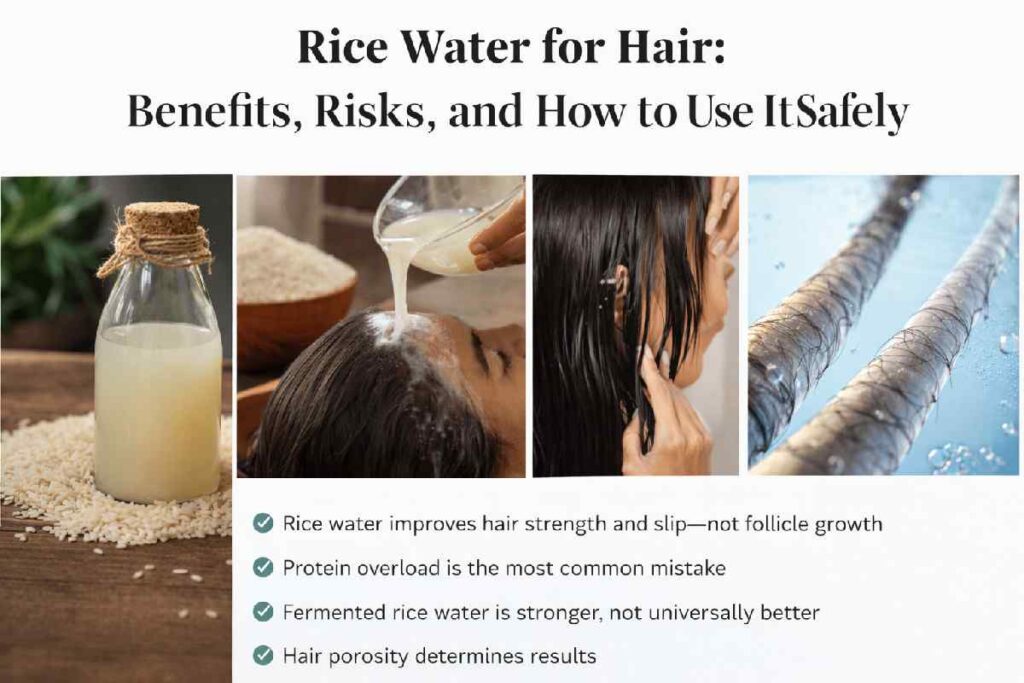
Rice water For Hair strengthens and smooths hair through protein and starch—but only when used correctly for the right hair type.Hair loss, breakage, dullness—most people turn to rice water hoping for regrowth. The problem? Hair doesn’t respond to folklore. It responds to chemistry. Rice water can absolutely improve the look and strength of hair, but misuse leads to dryness, snapping, and scalp irritation. This guide explains exactly how rice water works, who it helps, and who should skip it.
Key Takeaways
- Rice water improves hair strength and slip—not follicle growth
- Protein overload is the most common mistake
- Fermented rice water is stronger, not universally better
- Hair porosity determines results
- Less frequent use delivers better outcomes
What Rice Water Actually Does to Hair
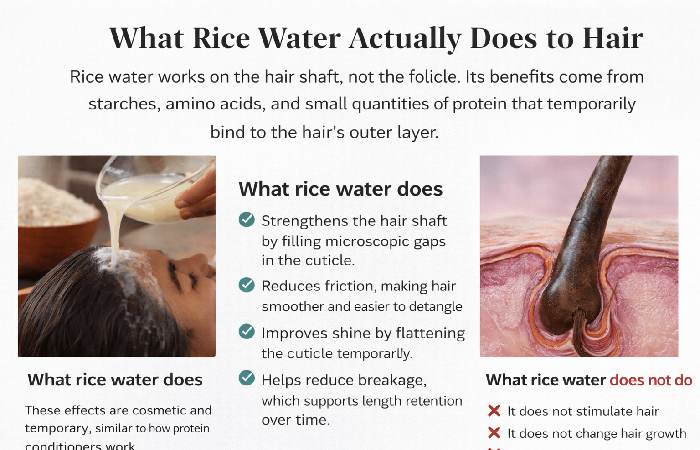
Rice water contains amino acids, starches, and inositol, which bind temporarily to the hair shaft. According to cosmetic science literature and organizations like National Institutes of Health, these compounds can reduce friction, increase shine, and reinforce weakened cuticles.
What it does not do:
- Regrow dormant follicles
- Alter genetics
- Replace medical hair-loss treatment
Rice water is a cosmetic conditioning treatment, not a biological growth solution.
How Long Should You Leave Rice Water on Your Hair?
Most people should leave rice water on their hair for 5 to 15 minutes—no longer. Keeping it on longer does not improve results and often leads to dryness or breakage.
Rice water works by temporarily coating the hair shaft with starches and proteins. Once the cuticle is coated, extra time only increases the risk of protein overload.
Recommended timing by hair type
- Fine or low-porosity hair: 5–8 minutes
- Medium-porosity hair: Around 10 minutes
- Coarse or high-porosity hair: 10–15 minutes max
Important safety rules
- Treat rice water like a protein rinse, not a deep conditioner
- Never leave it on overnight
- Always rinse thoroughly with plain water
- Follow with a moisturizing conditioner if hair feels tight
Signs you left rice water on too long
-
Hair feels stiff or rough after drying
-
Increased tangling or snapping
-
Loss of softness and elasticity
If you notice these signs, stop using rice water for at least 2–3 weeks and focus on moisture-based products.
Benefits of Rice Water for Hair (When Used Correctly)
When matched to the right hair type:
- Reduced breakage from surface reinforcement
- Improved shine and smoothness
- Temporary thickening effect (coating, not strand growth)
- Better manageability
These effects are cosmetic and reversible—but real.
Risks and Side Effects Most Guides Ignore
Rice water is protein-heavy. Overuse causes:
- Brittleness
- Dry, straw-like texture
- Snapping during detangling
Avoid rice water if you have:
- Low-porosity hair already prone to stiffness
- Protein sensitivity
- An irritated or flaky scalp
Fermented rice water increases risk due to acidity and microbial activity.
Fermented vs Plain Rice Water
| Feature | Plain Rice Water | Fermented Rice Water |
|---|---|---|
| Protein strength | Mild | High |
| pH level | Neutral | Acidic |
| Risk level | Low | Moderate–High |
| Best for | Fine, damaged hair | Coarse, resilient hair |
| Smell | Neutral | Strong |
How to Use Rice Water Safely
Basic soak method (recommended for beginners):
- Rinse ½ cup white rice
- Soak in 2 cups water for 30 minutes
- Strain and dilute 1:1
- Apply after shampoo
- Leave 5–10 minutes
- Rinse thoroughly
Never use as a daily leave-in.
How Often Should You Use Rice Water?
| Hair Type | Frequency |
|---|---|
| Fine / low porosity | Once every 10–14 days |
| Medium porosity | Once weekly |
| Coarse / high porosity | 1–2× weekly max |
| Chemically treated | Once every 2 weeks |
Rice Water by Hair Type
Curly / Coily:
- Dilute heavily
- Use as rinse-out only
Straight / Fine:
- Short contact time
- Avoid fermented versions
Colored / Bleached:
- Patch test first
- Follow with deep moisture
Rice Water vs Commercial Protein Treatments
| Factor | Rice Water | Commercial Treatments |
|---|---|---|
| Consistency | Variable | Controlled |
| Protein dose | Unmeasured | Precise |
| Risk | Higher DIY | Lower |
| Cost | Low | Moderate |
Illustrative pricing (not exact):
- DIY rice water: <$1 per use
- Salon protein treatment: $20–$50
How Long Do You Leave Rice Water on Your Hair?
Most people should leave rice water on their hair for 5 to 15 minutes—no longer.
Rice water works by temporarily coating the hair shaft with starches and proteins. Leaving it on too long does not increase benefits and often causes dryness or breakage.
Recommended timing by hair type:
- Fine or low-porosity hair: 5–8 minutes
- Medium porosity hair: 10 minutes
- Coarse or high-porosity hair: 10–15 minutes max
Important:
- Rice water should be treated like a protein rinse, not a deep conditioner
- Overnight use or long soaks increase the risk of protein overload
If hair feels stiff or rough after rinsing, the rice water stayed on too long or was too concentrated.
What Actually Helps Hair Grow Faster (Beyond Rice Water)?
Rice water does not make hair grow faster at the root. What it can do is reduce breakage, which helps you retain length over time.
If your goal is faster, healthier growth, these factors matter more:
Proven factors that support hair growth
- Scalp health: clean, non-inflamed scalp environment
- Adequate nutrition: protein, iron, zinc, vitamin D
- Low breakage routines: gentle detangling, minimal heat
- Consistent sleep and stress control
What rice water contributes
- Strengthens weak strands
- Reduces mechanical breakage
- Improves hair slip during styling
Bottom line:
Rice water supports length retention, not biological growth speed.
Is Rice Water Good for Your Hair? Honest Pros and Cons
Rice water can be good for your hair, but only under specific conditions.
When rice water is beneficial
- Hair breaks easily
- Hair feels limp or overly soft
- Hair needs temporary strength and shine
- Used occasionally and diluted properly
When rice water is NOT a good idea
- Hair feels hard or brittle already
- Hair is protein-sensitive
- Scalp is itchy, flaky, or irritated
- Used too frequently or undiluted
Key rule:
If your hair improves after use, continue cautiously.
If it feels dry, stiff, or tangles more—stop immediately.
Rice Water vs Protein Treatments: Which Is Safer?
Commercial protein treatments are generally safer and more predictable than rice water, especially for beginners or protein-sensitive hair.
The difference comes down to control and consistency.
Rice water (DIY protein)
Pros
- Very low cost
- Simple, natural ingredients
- Can strengthen weak hair when used correctly
Cons
- Protein concentration is unmeasured and inconsistent
- Easy to overuse
- Higher risk of protein overload, dryness, and breakage
- Results vary widely by hair type and recipe
Rice water behaves like an unregulated protein rinse. When it works, it works well—but when it doesn’t, damage happens fast
Evidence, Tradition, and Reality
Historical use (e.g., Heian-era Japan) shows cultural longevity—not scientific proof. Modern cosmetic research supports surface-level strengthening, not hair growth. Journals like the Journal of Cosmetic Science consistently frame protein treatments as supportive, not curative.
Author Trust & Methodology
This article synthesizes cosmetic chemistry, dermatological consensus, and historical context—rejecting viral exaggeration in favor of safe, evidence-aligned hair care. Reviewed using cosmetic science literature, dermatology guidelines, and historical sources (NIH, Journal of Cosmetic Science, Wikipedia).
FAQs
Does rice water really help hair grow?
No. It strengthens existing hair, which can reduce breakage and make hair appear longer over time.
Is fermented rice water better?
Only for certain hair types. It’s stronger and riskier.
Can rice water cause hair fall?
Yes—if overused or used on protein-sensitive hair.
How long does it take to see results?
Cosmetic effects appear after 1–3 uses.
Can I leave rice water in overnight?
No. This increases dryness and breakage risk.
Is rice water safe for colored hair?
Sometimes. Always dilute and patch test.
Which rice is best?
White rice is safest; brown rice increases protein load.
Is rice water good for dandruff?
Not recommended—fermentation may worsen scalp irritation.
Can men use rice water?
Yes. Hair biology is the same.
Is rice water better than oiling?
They serve different purposes—protein vs lubrication.
Should I stop if my hair feels hard?
Yes. That’s a classic protein overload sign.
Is this suitable for kids?
Generally no, due to sensitivity risk.