
Visualization works only when it is tied to structured mental rehearsal and real-world execution—not just positive thinking.
Most people try visualization at some point—imagining success, dreaming about goals—but see little to no results. That’s because simply “seeing yourself succeed” is not enough.
The real power of visualization comes from training your brain to execute actions, not just celebrate outcomes.
If used correctly, visualization becomes a rehearsal tool that prepares you for real-world performance—just like athletes, entrepreneurs, and high performers already do.
Key Takeaways
- Visualization must focus on actions, not just outcomes
- Mental rehearsal improves performance and confidence
- Consistency is more important than intensity
- Structured techniques outperform random methods
- Visualization works best when paired with daily habits
Why Visualization Alone Often Fails
Most advice online focuses on imagining success—wealth, fitness, achievements.
The problem? Your brain enjoys the reward without doing the work.
This creates a false sense of progress.
Instead of motivating you, it can actually reduce effort.
The fix:
Shift from outcome visualization → process visualization.
The Science Behind Visualization
Research from institutions like Harvard Medical School and Stanford University shows that mental rehearsal activates similar brain regions as physical practice.
This means:
- Your brain “practices” before real action
- Confidence increases
- Decision-making becomes faster
Athletes use this to simulate performance before competitions.
The Core Visualization Framework (Execution Loop)
Instead of random imagining, use this system:
Step 1: Define the outcome
Be specific (e.g., “earn ₹1 lakh/month from freelancing”).
2: Break it into actions
- Outreach
- Skill building
- Client delivery
3: Visualize execution
Imagine sending emails, talking to clients, solving problems.
4: Attach triggers
Link visualization to real actions (e.g., after morning coffee → start work).
Top Visualization Techniques for Success
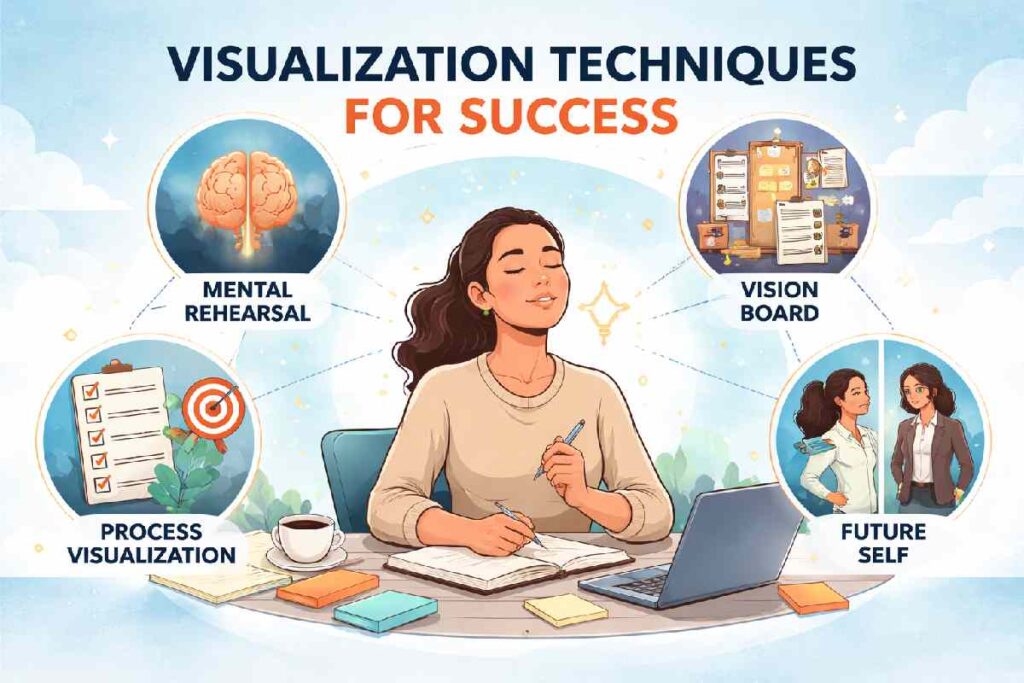
1. Mental Rehearsal
This is the most powerful technique.
You mentally simulate performing a task step-by-step.
Example:
A student visualizes writing an exam calmly and confidently.
2. Process Visualization
Instead of imagining success, you visualize the daily grind.
Why it works:
It prepares your brain for effort, not just reward.
3. Vision Mapping (Advanced Vision Board)
Traditional vision boards are random.
Upgrade it by including:
- Goals
- Steps
- Timelines
4. Future Self Visualization
Imagine your future identity.
Ask:
“What would my successful self do today?”
This builds alignment between identity and action.
5. Negative Visualization (Stoic Method)
Visualize obstacles:
- Failure
- Rejection
- Delays
This reduces fear and improves resilience.
Comparison Table of Visualization Techniques
| Technique | Best For | Strength | Limitation |
|---|---|---|---|
| Mental Rehearsal | Performance | High accuracy | Requires focus |
| Process Visualization | Habits | Builds discipline | Less exciting |
| Vision Mapping | Goal clarity | Structured thinking | Needs planning |
| Future Self | Identity | Long-term growth | Abstract |
| Negative Visualization | Risk control | Reduces fear | Can feel uncomfortable |
Country & Brand Comparison (Wellness Visualization Coaching)
| Country | Specialists | Reviews | Location | Pricing |
|---|---|---|---|---|
| USA | Mind coaches | High | Urban centers | $$$ |
| UK | Therapy-based | High | London-focused | $$$ |
| India | Life coaches | Growing | Tier 1 cities | $$ |
| Australia | Performance coaches | Moderate | Metro areas | $$$ |
| Canada | Hybrid coaching | High | Major cities | $$$ |
| Brand | Focus | Pricing | Location |
|---|---|---|---|
| Mindvalley | Personal growth | Premium | Global |
| Headspace | Meditation | Mid | Global |
| Calm | Relaxation | Mid | Global |
| BetterUp | Coaching | High | US/Global |
| InnerHour | Mental health | Affordable | India |
Yearly Growth Trend (Conceptual)
Visualization techniques have grown due to:
- Rise of self-improvement content
- Increased focus on mental health
- Performance psychology adoption
The trend shows steady upward interest globally, especially post-2020.
Common Mistakes
- Only visualizing success, not effort
- No action plan
- Practicing inconsistently
- Treating it as magic, not a tool
How to Build a Daily Visualization Routine
Simple 5-minute method:
- Sit quietly
- Visualize your next key task
- Imagine executing it successfully
- Start immediately
Best times:
- Morning (planning)
- Night (reflection)
Trust & Credibility Note
This guide is based on performance psychology principles, behavioral science insights, and real-world application patterns used by athletes, entrepreneurs, and high performers.
FAQs
1. Do visualization techniques really work?
Yes, but only when combined with action. Visualization enhances performance by preparing your brain, not replacing effort.
2. How long should I practice visualization daily?
Even 5–10 minutes is effective if done consistently and focused on real actions.
3. What is the best visualization technique?
Mental rehearsal is the most effective because it simulates real execution.
4. Can visualization replace hard work?
No. It supports hard work by improving clarity and confidence.
5. Why do most people fail with visualization?
They focus on outcomes instead of processes and lack consistency.
6. Is visualization backed by science?
Yes. Studies from Harvard and Stanford show brain activation similar to real practice.
7. Can beginners use visualization effectively?
Absolutely. Start with simple process visualization and build gradually.
8. Should I visualize success or failure?
Both. Success builds motivation; failure builds resilience.
9. How fast can I see results?
Some benefits like clarity and confidence appear quickly, but long-term results require consistency.
10. Is visualization useful for business or career growth?
Yes. It helps with decision-making, performance, and strategic thinking.