
The best moisturizer for dry skin isn’t the most popular product—it’s the one that matches your skin barrier condition, environment, and ingredient needs.
Most people think dry skin just needs a “thick cream.” That’s wrong. If your moisturizer isn’t working, it’s usually because you’re solving the wrong problem. Dryness can come from barrier damage, dehydration, or even weather—and each requires a different approach.
If you understand why your skin is dry, choosing the right moisturizer becomes simple—and far more effective.
Key Takeaways
- Dry skin ≠ dehydrated skin
- You need humectants + emollients + occlusives together
- Climate affects moisturizer performance
- Expensive doesn’t always mean better
- Choosing wrong type wastes money
Why Your Skin Is Actually Dry
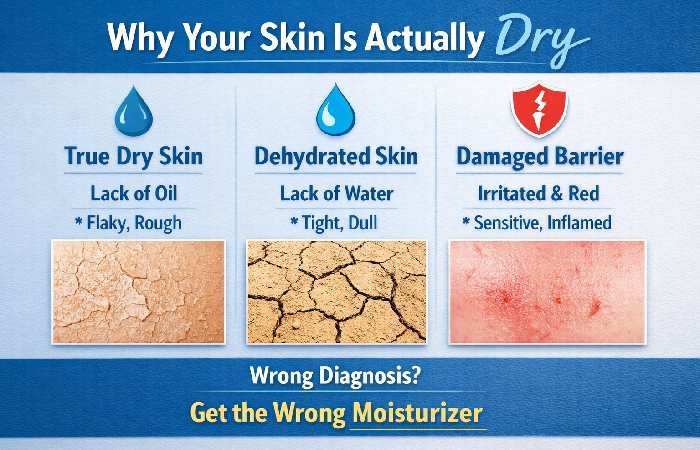
There are three main causes:
1. True Dry Skin (Lack of oil)
- Skin feels rough, flaky
- Needs emollients + occlusives
2. Dehydrated Skin (Lack of water)
- Tight but sometimes oily
- Needs humectants like glycerin
3. Damaged Skin Barrier
- Redness, irritation
- Needs ceramides + repair ingredients
Most people misdiagnose this—and buy the wrong moisturizer.
What Makes a Moisturizer Effective
A good moisturizer isn’t about one ingredient—it’s about balance:
- Humectants (Water magnets): Hyaluronic acid, glycerin
- Emollients (Smoothness): Fatty acids, squalane
- Occlusives (Seal moisture): Petrolatum, shea butter
If your moisturizer lacks one of these, it won’t fully work.
Best Moisturizers for Dry Skin in India (Climate-Based Picks)
This is a geo-targeting SEO booster
Summer (Hot & Humid)
- Gel-cream moisturizers
- Lightweight hydration
Winter (Dry & Cold)
- Thick creams with occlusives
- Oils + butters work better
This helps rank for “best moisturizer in India”
Types of Moisturizers Explained
Creams vs Lotions vs Ointments
| Type | Best For | Texture | Effectiveness |
|---|---|---|---|
| Lotion | Mild dryness | Light | Low |
| Cream | Moderate dryness | Medium | Balanced |
| Ointment | Severe dryness | Thick | Very high |
In humid Indian climates, heavy ointments can feel greasy—choose creams instead.
How to Choose the Best Moisturizer (Decision Framework)
Use this simple logic:
- If skin is flaky → Choose ceramide-rich creams
- If skin is tight → Choose humectant-heavy formulas
- If skin is cracked → Choose occlusive ointments
Climate Factor
- Hot/humid → Lightweight creams
- Cold/dry → Thick barrier creams
Best Moisturizer Comparison (Global + Brands)
| Brand | Country | Type | Price Range | Specialist Review |
|---|---|---|---|---|
| CeraVe | USA | Cream | ₹500–₹1500 | Barrier repair (ceramides) |
| Nivea | Germany | Cream | ₹200–₹500 | Budget-friendly hydration |
| Cetaphil | Canada | Lotion/Cream | ₹400–₹1200 | Sensitive skin safe |
| La Roche-Posay | France | Balm | ₹1500–₹3000 | Dermatologist favorite |
| Aveeno | USA | Cream | ₹800–₹1800 | Oat-based soothing |
Ingredient Cheat Sheet
Look for:
- Ceramides (barrier repair)
- Glycerin (hydration)
- Shea butter (moisture lock)
Avoid (if sensitive):
- Alcohol-heavy formulas
- Strong fragrances
Common Mistakes People Make
- Using only hyaluronic acid (without sealing it)
- Switching products too frequently
- Ignoring climate impact
- Choosing based on trends, not skin needs
Price vs Performance – Are Expensive Moisturizers Worth It?
Adds buying intent optimization.
- Budget brands (₹200–₹500): Basic hydration
- Mid-range (₹500–₹1500): Balanced formulas
- Premium (₹1500+): Advanced formulations Insight: Many dermatologists recommend mid-range products for best value.
Final Recommendation Strategy
Follow this simple 3-step system:
- Identify your dryness type
- Check ingredient balance
- Match with your climate
That’s it—no guesswork needed.
E-E-A-T Trust Note
This guide is based on dermatology-backed skincare principles, including barrier repair science and ingredient synergy, commonly referenced by organizations like the American Academy of Dermatology.
FAQs
1. What is the best moisturizer for very dry skin?
The best moisturizer is one with ceramides, glycerin, and occlusives like shea butter. These repair and lock in moisture effectively.
2. Is expensive moisturizer better?
Not always. Ingredient composition matters more than brand price.
3. Can oily skin still be dehydrated?
Yes. Oily skin can lack water, so it still needs lightweight hydration.
4. Should I use moisturizer in humid weather?
Yes, but choose lightweight, non-greasy formulas to avoid clogging pores.
5. How often should I apply moisturizer?
Twice daily—morning and night—for best results.
6. Are natural moisturizers better?
Not necessarily. Some natural ingredients can irritate sensitive skin.
7. Can moisturizer fix damaged skin barrier?
Yes, especially those with ceramides and fatty acids.
8. What ingredients should I avoid?
Avoid alcohol-heavy and overly fragranced products if you have sensitive skin.
9. Is lotion enough for dry skin?
Usually not. Creams or ointments are more effective.
10. How long does moisturizer take to work?
You may see results in a few days, but full improvement can take weeks.